Showing posts sorted by date for query co-founded Newport. Sort by relevance Show all posts

Thursday, January 16, 2020

Mary Dyer and Social Justice

A script commissioned by Julie Esker Dishman

© 2019 Christy K Robinson

This article is copyrighted. Copying, even to your genealogy pages, is prohibited by US and international law. You may "share" it with the URL link because it preserves the author's copyright notice and the source of the article.  
All rights reserved. This book or blog article, or any portion thereof may not be reproduced or used in any manner whatsoever without the express written permission of the author except for the use of brief quotations in a book review.


If you’ve heard of Mary Barrett Dyer, who lived in the mid-1600s, it’s probably as a Quaker woman who was hanged because of her religious beliefs. But historical research shows that Mary Dyer—married in an Anglican service, emigrated to Boston in 1635 as a Puritan, banished as an Antinomian heretic, co-founded Rhode Island as a non-conformist, possibly worshiped with Baptists, became a Quaker in England—actually was hanged for her civil disobedience! 

From 1657, she was arrested and jailed in New Haven and Plymouth colonies, and was in and out of prison in Massachusetts Bay Colony, some say because she preached. But there’s no record of her spoken words, nor a record of her being whipped, the fate of women who taught religion to men.


Learn more about Mary Dyer: http://bit.ly/TopTenMaryDyer 


We know from her only surviving letter, written from prison to the General Court in Boston, that her mission there was, in “love and compassion,” to “offer up her life for truth and people’s sakes” to force the theocratic government to repeal its laws that whipped, imprisoned, seized property, and executed Quakers and other religious dissenters. She demanded that the government “let the truth and the servants of God have free passage” in the colony. She said on Shelter Island that she went to Boston “to try the bloody law.” 


Mary Dyer was reported as lovely, well-spoken and educated, and had social advantages with her well-connected husband, a prosperous mariner, farmer, and the first attorney general in America. The Boston government did not want to make a martyr of her and begged her to leave and be safe in Rhode Island. But Mary used those advantages to force their response.

After they hanged her in 1660, English Quakers rewrote and edited her letter to elicit tolerance for their cause. As a result, King Charles II put an end to colonial executions for conscience’s sake. He also ratified the Rhode Island charter of 1663, which brought religious liberty and free passage in New England, as Mary had demanded. That charter was used as a template for the US Constitution’s Bill of Rights.

What Mary Dyer and the Rhode Island founders sent down through the ages with their testimonies and documents, was justice, mercy, compassion, and equality for all people of all faiths, all nationalities. Their philosophy of separation of church and state allowed for a wide spectrum of belief and behavior without oversight by government or regulators. Most were godly people who knew firsthand the persecution and oppression of theocracy.

They encouraged kindness and tolerance without demanding conformity to one dogma or creed. Instead of stealing land, they purchased it for a fair price, and they were reluctant to make war on Native Americans.

Extending those qualities to social issues today would mean that we don’t dehumanize refugees in crowded pens with inhumane conditions. We don’t withhold health care, shelter, or sustenance from the elderly, the disabled or infirm, or children or strangers among us. It would mean that government officials don’t take bribes or benefit financially from their elected or appointed positions, and that political campaigns are financed by the people of that jurisdiction instead of billionaires and corporations.           

The legacy of Mary Dyer’s exemplary life and sacrificial death is that under our Constitution, we have the freedom—apart from government—to speak, to freely assemble, to protest, and to worship according to our conscience—what they called “soul liberty” in her day. Today we call them basic human rights. 

As people of firm faith in one religion or another, or people of no faith, we all have a responsibility to nurture one another and to care for our planet, recognizing the liberty and human rights of future generations.
The Golden Rule transcends time, religions, and cultures.

*****

Christy K Robinson is author of these sites:  

and of these books:

·          We Shall Be Changed (2010)
·          Mary Dyer Illuminated (2013)
·          Mary Dyer: For Such a Time as This (2014)
·          The Dyers of London, Boston, & Newport (2014)
·          Effigy Hunter (2015)
·          Anne Marbury Hutchinson: American Founding Mother (2018)


Sunday, December 22, 2019

“Purifying” the customs and fun of Christmas

Why our ancestors didn’t celebrate the holiday

© 2019 Christy K Robinson

This article is copyrighted. Copying, even to your genealogy pages, is prohibited by US and international law. You may "share" it with the URL link because it preserves the author's copyright notice and the source of the article.  
All rights reserved. This book or blog article, or any portion thereof may not be reproduced or used in any manner whatsoever without the express written permission of the author except for the use of brief quotations in a book review.


Even as I finish out my 50th year as a church musician, playing keyboards for church preludes and choir parties, and accompanying vocalists and congregations during Advent and Christmas, I remember how our ancestors responded to holiday events in the 17th century.

Brueghel the Younger: Adoration of the Magi, late 16th century.

For a thousand years, European ancestors had celebrated Christ’s “birth” at midwinter with religious services, fasts and feasts (Advent was a four-week modified fast leading up to the Christmas feast and then 12 days of feasts and parties). It was during the religiously stringent mid-17th century that Christmas took a punch to the gut in Protestant England and New England.

The Christian church had adopted many pagan seasonal customs and co-opted their celebrations while proselytizing and building their culture and governments. The Yule, the holly and mistletoe, gift-giving, festivals of light and feasting, saint miracles, and much more originated thousands of years ago. But as Puritans, Separatists, and other non-conformists saw it, the “Christ-mass” was a bastardization of pagan revels with Roman Catholicism. Puritans (a.k.a. Congregationalists) had a mission to purify and purge Christianity of its sinful ways and prepare people for the imminent second advent of Christ.

The banning of Christmas celebrations has often been attributed to Oliver Cromwell, Lord Protector of the English Commonwealth from 1553 to 1558.  The Parliamentary bans, however, occurred while he was a general, fighting decisive battles in the first English Civil War. 
Cromwell didn't outlaw or ban Christmas,
but it makes a fun meme!
1644, England 
“Whereas some doubts have been raised whether the next [regularly scheduled last Wednesday of every month] Fast shall be celebrated, because it falleth on the day which heretofore was usually called the feast of the Nativity of our Saviour [Christmas]. The Lords and Commons in Parliament assembled doe order and ordaine that publique notice be given that the Fast appointed to be kept on the last Wednesday in every moneth ought to be observed untill it be otherwise ordered by both Houses of Parliament: And that this day in particular is to be kept with the more solemne humiliation, because it may call to remembrance our sinnes, and the sinnes of our forefathers, who have turned this Feast, pretending the memory of Christ into an extreame forgetfulnesse of him, by giving liberty to carnall and sensuall delights, being contrary to the life which Christ himselfe led here upon earth, and to the spirituall life of Christ in our soules for the sanctifying and saving whereof Christ was pleased both to take a humane life, and to lay it down againe.”

1647, England and Wales 
“All Festivals and Holy Days abolished; …  Forasmuch as the Feasts of the Nativity of Christ, Easter and Whitsuntide [Pentecost], and other Festivals commonly called Holy-Dayes, have been heretofore superstitiously used and observed Be it Ordained, by the Lords and Commons in Parliament assembled, That the said Feast of the Nativity of Christ, Easter and Whitsuntide, and all other Festival dayes, commonly called Holy-dayes, be no longer observed as Festivals or Holy-dayes within this Kingdome of England and Dominion of Wales, any Law, Statute, Custome, Constitution, or Cannon to the contrary in any wise notwithstanding[.] “

New England Separatists (Pilgrims) and Puritans were more zealous, more fundamentalist, more strict than their friends and brethren in England. Christmas was not celebrated in Plymouth Colony in 1621, as noted in my article HERE, and celebrations were much-frowned-upon by the theocracies of Massachusetts Bay, Connecticut, and New Haven in the 1630s and 1640s even while under the authority of King Charles I. As in England, people were encouraged to tattle on their neighbors who brought greenery into the house or held a Christmas feast or gave gifts.

1651, Massachusetts Bay Colony
When it comes to assigning “blame” for the banning of Christmas celebrations in New England, we could choose among several members of the theocratic government: Rev. John Cotton, Rev. John Wilson, Gov. Richard Bellingham, Sec. Edward Rawson, or Gov. John Endecott (Endecott is my suggestion for instigator because of his fanatical leanings, and his persecution of Baptists, Quakers, and others who would not conform to his narrow beliefs).
Source: The Charters and General Laws of the Colony and Province of Massachusetts.

 
Satanical practices! Woe, woe!

The ordinance about Christmas is invariably listed between ordinances on gaming, dicing, and games of chance (bad, very bad!), so it might be reasonable to assume that one of the chief detractions of Christmas observance was not going to labor, not praying at home, and instead, getting intoxicated and gambling at the ordinaries. Ordinaries were licensed to sell beer and entertain travelers, and sometimes served as a community meetinghouse while church buildings were constructed. Gambling there was punishable by the same 5-shilling fine as celebrating Christmas. 

Were they dour and austere all the time?
As I researched history and sociology for my own books, I saw that Puritans had fun, drank alcohol (not to drunkenness), danced (not mixed sexes), had competitions like shooting and sword play, cooking and needlework, top skills or speed in building and construction, etc. They had after-church potlucks particularly for the people who had come to the city from smaller towns. They held concerts. They held harvest festivals and spring planting parties, and when they slaughtered their stock in November, that was hard work in smoking/cooking/drying the meat, as well as preserving the hides and using the bones and tallow—followed by food and music. They had wedding celebrations. They did like to party, but it was always with a religious, moral aspect to it because that was a shared belief.

Rhode Island charter of 1663
But in Rhode Island?
How did William and Mary Dyer, or William and Anne Hutchinson, or all their colleagues, friends, and family celebrate religious holidays? They almost certainly did not. They came from a Puritan background in the 1620s and 1630s, when they emigrated from England to Massachusetts, which was a Puritan theocracy.  They founded a secular democracy (a non-religious government) in Rhode Island in 1638, and though they were dissenters to Puritanism, their culture still did not include what they would have considered pagan or Catholic-origin celebrations. In the 1640s, the Rhode Island Assembly, to which William Dyer was secretary and recorder, met on December 25 to conduct quarterly business. There was no mention of a holiday—it was just another winter day on which to conduct colonial business.

Holy-day celebrations were restored in 1660, when King Charles II was restored to the throne of Great Britain and the colonies, the Anglican church and its Book of Common Prayer were accepted once more, and soon after, Rhode Island was given its religious liberty in a new charter obtained from King Charles. Along with their permission to worship (or not) as their conscience dictated, there was a flowering of religious traditions: Anglican, Congregational, Presbyterian, Lutheran, Quaker, Baptist, Antinomian, and soon, Methodism and the many denominations of the 19th century.

It would take many years for the stigma of paganism or Roman Catholicism to be cast off of Christmas and Easter. Even in the 1970s, when I was a teenager, my denomination, which originated in New England, frowned upon Christmas trees and decorations in churches and homes, because of pagan origins that had been adopted by other Christian denominations. We had Christmas hymns in the hymnals, and choral performances of Handel’s Messiah because of its biblical libretto, but choir anthems were few.

It’s only been in the last few decades that Christmas has been embraced by most denominations as a family occasion where the gospel can be presented to non-believers.

Whatever your traditions and beliefs are, religious or secular, I wish for you peace, joy, health, and fulfilling relationships in the year to come.

And now for a little Quaker humor in honor of Mary Barrett Dyer: 


shortened link for this article: http://bit.ly/2SpKobX


*****
Christy K Robinson is author of these books (click the colored title): 
Mary Dyer Illuminated Vol. 1 (2013)  
Effigy Hunter (2015)  

And of these sites:  
Discovering Love  (inspiration and service)
Rooting for Ancestors  (history and genealogy)
William and Mary Barrett Dyer (17th century culture and history of England and New England)

Friday, March 15, 2019

Women’s History Month Spotlight: Mary Barrett Dyer

© 2018 Christy K Robinson

This article is copyrighted. Copying, even to your genealogy pages, is prohibited by US and international law. You may "share" it with the URL link because it preserves the author's copyright notice and the source of the article.  
All rights reserved. This book or blog article, or any portion thereof may not be reproduced or used in any manner whatsoever without the express written permission of the author except for the use of brief quotations in a book review.


During Women’s History Month, we often hear the stories of women in recent history.  This article celebrates a woman who gave her life to force the New England theocracy to stop persecuting (fining, beating, torturing, hanging) those who believed differently than the fundamental dogma. Meet Mary Barrett Dyer, 1611-1660.

Mary Barrett was raised in London, to parents history has lost track of. Unusually for a girl of her era, she was well educated and could converse on traditional “men’s” subjects. She could write, which not all men could do, and she had knowledge of several religious denominations: she was married as an Anglican, she was admitted to membership in Boston First Church of Christ (Puritan), joined the Antinomian movement of Anne Hutchinson, and became a Friend (Quaker) in the 1650s.  She married William Dyer, a remarkable man, in 1633, and they joined about 35,000 Puritans in the Great Migration to Boston in 1635.

Boston, Massachusetts Bay Colony, had been founded as the City Upon a Hill by members of the Winthrop Fleet in 1630. It was meant to be a New Jerusalem where the theocratic government and utopian society would usher in the second coming of Christ. They’d seen the signs of the end with blood moons, solar eclipses, starfalls and comets, earthquakes, and believed the Elect (those who God predestined to salvation) would be taken to heaven in their lifetimes.
Mary Dyer at the Friends Center, Philadelphia, Pennsylvania
Artist: Sylvia Shaw Judson

The Bay Colony was governed by Puritan ministers and magistrates who were far more zealous or fanatical than English Puritans. Plainly and simply, it was a theocracy. The voters and jurymen were freemen who were members of their churches—and membership was not easy to obtain without an interview, personal testimony, and recommendations. Those who committed adultery were subject to severe whippings and possibly hanging, and members were encouraged to report crimes for the purpose of purifying the church and greater community. They were known to drop in on other members and quiz their children on their catechism. The Massachusetts Bay founders believed that religious error or dissent from their dogma was treasonable.

Along came Anne Hutchinson, who turned Massachusetts on its ear by teaching Bible studies in her home, emphasizing the New Testament covenant and salvation by grace, in contrast to the adherence to Old Testament laws and trying to be saved by keeping religious and ceremonial laws. Mary Dyer was one of Anne’s friends, and Gov. John Winthrop described Mary as “a very proper and fair woman, and both of them notoriously infected with Mrs. Hutchinson's errors, and very censorious and troublesome, (she being of a very proud spirit, and much addicted to revelations)."

One of the main accusers of Hutchinson and Dyer was Rev. Thomas Weld, who accused the Hutchinson followers of gaining adherents by
“Being once acquainted with them, they would strangely labour to insi­nuate themselves into their affections, by loving salutes, humble carriage, kind invitements, friendly visits, and so they would win upon men, and steal into their bosoms before they were aware. Yea, as soon as any new-comers (especial­ly, men of note, worth and activity, fit instruments to advance their design) were landed, they would be sure to welcome them, shew them all courtesie, and offer them room in their own houses, or of some of their own Sect…”

That sounds to my 21st century ears like community outreach  or personal evangelism. To the 17th century Puritans, it was a seditious political movement that threatened the vision of the City Upon a Hill.

Mary’s husband William was involved with Hutchinson’s religious and political movement in Boston, and signed a remonstrance against the government. Just before he had his civil rights revoked, Mary gave stillbirth to the first “monster” in America: a seven-months anencephalic and spina bifida-afflicted girl. Only a few people knew of it in October 1637, but when Anne Hutchinson was excommunicated in 1638, Mary took Anne’s hand as she was told to depart the meetinghouse, and someone told the crowd that Mary was the mother of a monster. The fetus was exhumed and it was pronounced God’s judgment on her heresy. 

Mary and William co-founded both Portsmouth and Newport, Rhode Island, with William taking an active role in government, including being appointed first Recorder, first Secretary of State, first Attorney General, and Commander in Chief Upon the Seas for New England. Rhode Island formed the first democracy disconnected from ecclesiastical control. From 1635-1650, Mary bore six children who lived to adulthood.

In 1652, just before the Anglo-Dutch naval war broke out, William was sent to England to secure a new charter of liberties and his naval commission, and Mary sailed there, too. She stayed, probably with influential family friends, until early 1657. She had been “convinced” as a Quaker during that time. Quakers were not popular in England or America because of their criticism of orthodox religion, their radical behavior in disrupting churches, and because they encouraged women to testify and preach. In 1656, the first Quaker missionaries arrived in southern New England. They were arrested, tortured, suffered confiscations of their farms, and then tried in court. They schooled the magistrates, asking what law they’d broken. The theocrats hastily created laws after the fact, to viciously persecute and kill these nonconformists. 

Mary knew exactly what she was coming home to in 1657. She intentionally sailed for Boston, rather than for her home ports in Rhode Island, a haven for religious nonconformists. The Massachusetts assistant governor promptly cast her into prison because of her Quaker beliefs. Already being famous as the mother of the monster, they knew she had a high social status because of her husband.

Over the next two and a half years, Mary was jailed several times for civil disobedience—not her religion. Surrounding colonies banished her “on pain of death” if she returned. Nevertheless, she persisted. They didn’t want to hang her and create a martyr, so she was released several times. They hanged two Quaker men in 1659, but their deaths had no effect on the bloody laws. Mary decided they needed a woman to protest, and give up her life if necessary—an educated, beautiful woman who was the perfect wife and mother, and famous at that. In May 1660, she returned to Boston at the time when the city was crowded for elections and courts. She showed up at the prison to encourage the Quakers inside, but apparently also to make her presence known. She was cast into prison, given a chance to go home, shut up, and be safe, but she refused.

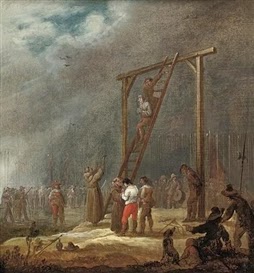
On June 1, 1660, Mary Dyer marched a mile from the prison to the gallows on Boston Neck, with a large militia escorting her. They weren’t there to protect Mary: the crowd had sympathy for her. The pikemen and musketeers were there as security for the government officers and ministers who reviled her.

Mary recognized her duty to speak to oppression, and to the torture and imprisonment of her fellow believers. Her death was reported to King Charles II, who wrote an order forbidding capital punishment for religion based on a letter Mary wrote. Two years later, he ratified a new, groundbreaking charter (which William Dyer had a hand in) for Rhode Island, guaranteeing religious freedom and liberty of conscience.  It was one of the templates for the U.S. Constitution, 130 years later. Other countries have modeled their constitutions and rights on those of the United States: these liberties have become global.

Does Mary Dyer still have the ability to inspire you, 
400 years later, or are you content to say that she was your ancestor, and then change the subject? 

The battle for religious liberty, though encoded in law and enshrined in the Constitution, rages on even to this day. Stay vigilant. Note that federal and Supreme Courts, Congress, state legislatures, lobbyists, and media influencers have a hard grip on your freedoms. Write or call, and give them a piece of your mind. Do it often. They work for us.

It’s time for you and all of us to summon the courage and vision of Mary Dyer.


*****
Christy K Robinson is author of these books:
Mary Dyer Illuminated Vol. 1 (2013)  
Effigy Hunter (2015)  

And of these sites:  
Discovering Love  (inspiration and service)
Rooting for Ancestors  (history and genealogy)
William and Mary Barrett Dyer (17th century culture and history of England and New England)


Tuesday, May 8, 2018

Kirkby La Thorpe’s Church of St. Denys


© 2018 Christy K Robinson 
This article is copyrighted. Copying, even to your genealogy pages, is prohibited by US and international law. You may "share" it with the URL link because it preserves the author's copyright notice and the source of the article.

Photos by Roy Hackford, used by permission. Click to enlarge photos.

Church of St. Denys, view from southwest.
 It’s fascinating to learn the history of a place or a building that we see as a static, finished piece of fabric, and realize that it’s been changing for a thousand years or more, as generations of people have come and gone. It will continue to change during our lives and after we're gone.

The village of Kirkby La Thorpe, Lincolnshire, was the birthplace of William Dyer, 1609-1677, the polymath and accomplished man who married Mary Barrett Dyer.

Whether or not you're related to anyone who lived in this sleepy English village, it's enlightening to learn that what happened to this church also happened to large and small churches all over the British Isles for your ancestors. Churches were built and altered and enlarged in stages, and it's fair to say that those changes were part of the fabric of our ancestors who sent their experiences and DNA down the years to all of us.

The church in Kirkby La Thorpe
The church of St. Denys (a martyred evangelist) is listed as Grade II*, included among “particularly important buildings of more than special interest.” At this time, in 2018, the church is closed to services and undergoing repairs, so when Roy Hackford, a Lincolnshire history buff, agreed to take interior photos for me if he could get the key, he found it cluttered with boxes and banners, chairs askew, kneelers pushed aside, and the curtains slung over the rood screen. These photos are the first interior views available, ever, on the internet. (I’ve searched for interior shots for more than 10 years, trust me!) So please look past or through the repairs and painting supplies, to the “bones” of the ancient building, and send good thoughts to the parish, in hope of a day soon, when the church is once again the center of peace and beauty. It would be wonderful to have a pictorial update.
If this is the same church key used 400 years ago, it was
held by William Dyer the Elder, the churchwarden.

Who lived in Kirkby La Thorpe:
  • William Dyer the Elder, and his wife (unknown name at this time). He was a yeoman farmer (meaning he owned property instead of being a tenant) and churchwarden (he was literate) of Kirkby La Thorpe in 1609-1610. Birth and death unknown.
  • Son, Nicholas Dyer, born 1606.
  • Son, William Dyer, baptized September 19, 1609 in the church of St. Denys on Church Lane. Probably attended the Carre School in Sleaford, took London apprenticeship in 1624; married Mary Barrett in 1633; emigrated to Massachusetts in 1635; co-founded Newport, Rhode Island 1639; became clerk, secretary of state, recorder, general solicitor, first attorney general in all of America, naval commander in Anglo Dutch War, etc.; haberdasher, mariner, farmer, father of seven; died 1677 in Newport, RI.  
  • Daughter, Margret Dyer, born about 1610.

Kirkby La Thorpe is a village on the Boston Road between Sleaford and Boston, Lincolnshire. It’s a linear village (along a single road) in the fenlands of eastern England, with houses built along a low ridge. The church of St. Denys, at the end of Church Lane, is the highest point, which makes sense as a place of refuge in times of flooding.

The village has existed at least since Iron Age times, and there was a Saxon settlement, seen in ditch and bank earthworks across the road from the church. There may have been three medieval manors in this parish, according to the Domesday Book. The nearby fields have ridges and furrows called selions, that remain from medieval partition of farmlands, and their plowing practices.

Page of the Domesday Book, Lincolnshire folio,
where Kirkby LaThorpe is the first entry.

Households 

    • Households, 61, including 5 villagers. 14 freemen. 5 smallholders.

Land and resources 

    • Ploughland: 4 ploughlands. 1 lord's plough teams. 3 men's plough teams.
    • Other resources: 0.5 churches.

Valuation 

    • Annual value to lord: 8 pounds in 1086; 4 pounds in 1066.

Owners 

Photo © Christy K Robinson
 The chief businesses were the wool industry, fowling (waterfowl for meat and feathers), and agriculture. Today, there are crops and seed companies still in the area. If you’ve seen images of “fields of gold,” as in the song by Sting, you’re seeing the yellow flowers of the rapeseed plant whose seeds become feed for animals and canola oil for humans. The town of Boston, about 15 miles to the east, was the port through which wool was exported to weavers in the Netherlands and Flanders in medieval and renaissance periods.

Once upon a time
At various times after the Norman Conquest in 1066-67, the church in Kirkby La Thorpe belonged to Earl Morcar; and 20 years later, King William I and the Bishop of Durham shared revenues in equal portions.

It is suggested that there was a high status pre-Conquest church in Kirkby la Thorpe, due to the place-name and the presence of Saxon sculpture. The 'kirk' element of the name is normally that given by the Danes to villages in which the Danes found a church on their arrival, which suggests that there was an important pre-Conquest church in Kirkby. Paul Everson and David Stocker. 1999. Corpus of Anglo-Saxon Stone Sculpture. Lincolnshire. page 74. https://www.lincstothepast.com/St-Denys--church-and-churchyard/239393.record?pt=S

There were two churches in Kirkby’s area, but the church of St. Peter, which may have had a monastic function, was closed in 1593, sixteen years before William Dyer was born. It was demolished in 1637, the year he was disfranchised in Massachusetts Bay and Mary had the anencephalic fetus.

Description of church interior
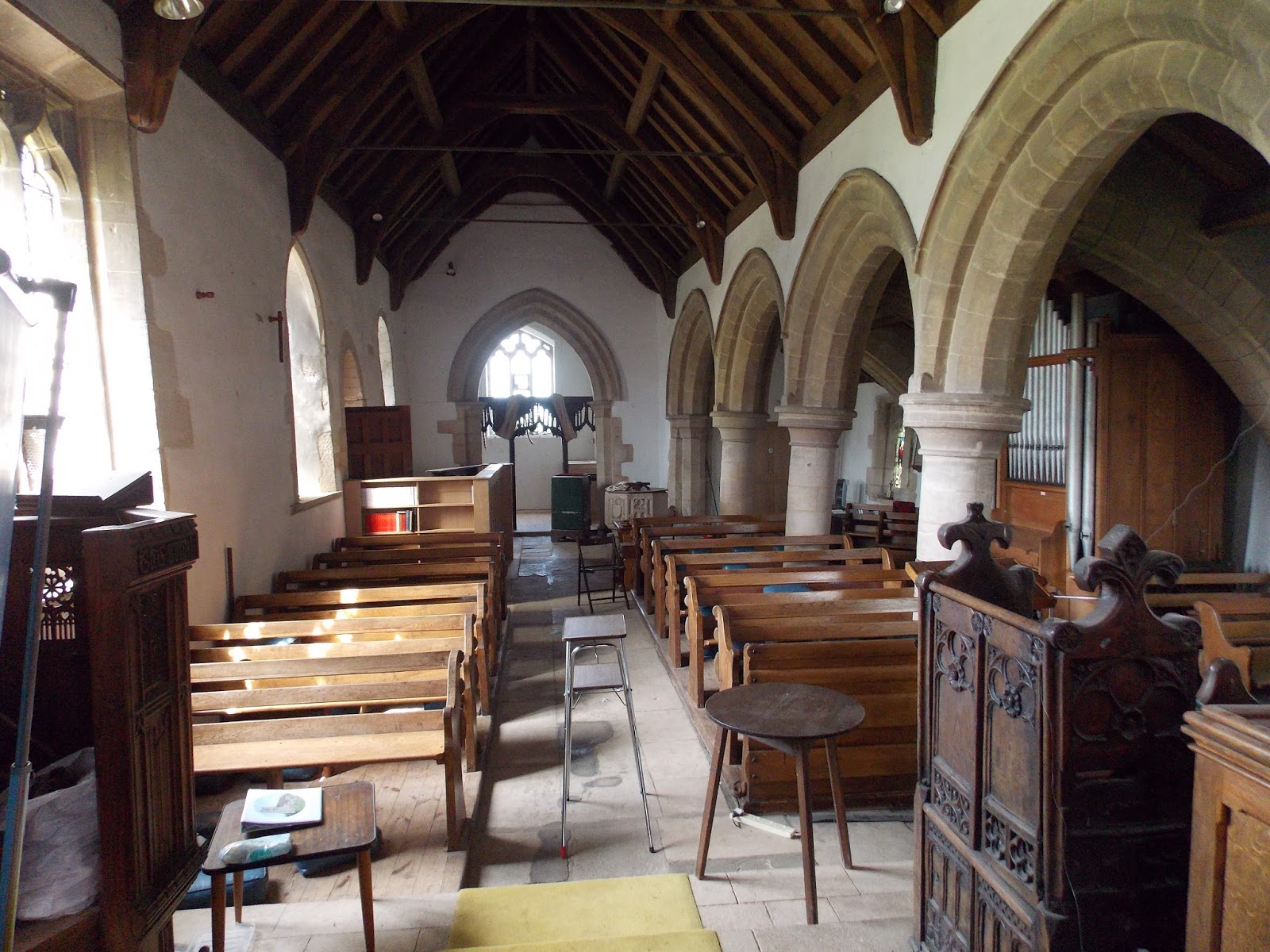
View of the nave and tower arch from the chancel.

The nave is the largest space of the church building, and it’s where the pews or chairs are set (for the last 400 years). From the 16th century and back, the congregation stood for service or Mass.  On 16 October 1246, King Henry III granted a market and fair to the Hospitallers at the Kirkby manor, and the fair was held annually on 25 July at the manor. However, church naves in many towns were the place to strike deals, buy and sell livestock, and a community gathering place for social events, proclaiming the will of the government, and organizing workers for the strip farms in the area. That’s a good reason to screen the chancel and altar from the nave. They didn’t consider the often-secularly used building to be the “church,” in the biblical sense of church. The church was the people. 

On the south wall of the nave (the good side, not the demon side), there is a 13th century piscina, a basin built into the wall where holy water was kept, to cleanse the plate and cup used for the Eucharist. This one has a plain, pointed arch molding around it.

The 1925 organ is in the north aisle. You can
see the romanesque (Norman) arches and pillars
behind the Victorian-era pews.
A four-bay arcade (meaning four arches along the sides of the nave, where the congregation stood or sat) is “transitional,” a period between Norman and English Gothic. The arcade arches are almost round, indicating a Norman origin. The pillars and capitals are round and currently undecorated, though they may have been brightly painted in medieval times. 

There is a north aisle on the other side of the arcade, and on the exterior, there are buttresses to carry the weight of the lead roof down to the ground. The small pipe organ in the north aisle is a “Premier” Organ built in 1925 by Cousans, who say that "These models were particularly popular in smaller churches because of their small dimensions but big sound."

The church was restored in the 19th century, and much of the stone floor looks very plain, compared to hundreds of other churches this old. It was probably originally tiled in four-inch black and red ceramic tiles as seen all over the UK, and many clerics and local people would have been buried in a sub-floor crypt, facing east toward Christ’s second coming. 

In fact, Roy told me that some of the stone slabs in the center aisle and chancel had faint inscriptions on them, made illegible by hundreds of years of foot traffic. This, too, is common in large and small churches. In-church inhumations were discontinued (except by special license) in the 19th century because of decomposition smells and the fear of disease.

View of the nave (foreground), chancel and pulpit (right),
north aisle with early windows (left), and oak prayer desk beneath the
niche for access to the rood screen (center).


 An oak prayer desk (as distinguished from the lectern and the pulpit) sits on the step of the chancel, under the nook where the rood screen stretched across the chancel. A description calls the desk "made from C14 bench ends decorated with blank cusped panels and fleur de lys terminals." I haven't seen when the desk may have been built, but perhaps during a renovation of the mid-19th or early-20th century.

Memorials
 
There are painted-glass windows to the memory of Rector John Gorton and Alfred Anders, as well as a brass plaque for Maria Adamson. Although the painted glass is dated to the 1911 restoration of the chancel, the east window of the north aisle is said to contain bits of medieval glass. 

A glassed and framed print remembers the service of local men in the Great War (WWI). There’s a pedimented ashlar wall plaque to William Willerton, d.1845. In the reveal of the chancel south window, a small rectangular brass plate records the charitable donations of the Rev. Thomas Meriton, d.1685. If there were ever medieval effigies in a village parish church like St. Denys, it’s doubtful, because they’d have preferred grander churches like St. Andrew’s in Ewerby, or a church in Heckington, Sleaford, Boston, or Lincoln.

St. Denys churchyard near the porch.
Outside, there are numerous slate headstones, but the earliest inscriptions to be seen date back to the early 1800s. The church website notes that there is still plenty of space for burials in the churchyard. And because the church site is more than a thousand years old—perhaps 1,400 years—there are probably hundreds of unmarked burials outside, and some under the church floor.

We don’t know what happened to William Dyer’s immediate family after his sister Margret was baptized in 1610. There are no more records. They may have died in a plague, lost their land in economic upheaval of the era, or sold up and moved away. But it’s also possible that the churchwarden and his wife are buried in or just outside the church of St. Denys.

South door and porch
Wooden south door to the church, with
rounded Norman-era arch overhead. The
arch may be 1,000 years old.
 The south door of the church has a Romanesque, barrel-shaped tympanum over the door, which was common in Norman churches of the 11th and 12th centuries. Couples were wed in the doorway of a church, then moved inside to the altar rail to take Mass or Communion. To the right of the wooden door is a niche called a stoup where people dipped their fingers into holy water before entering.

Church tower
St. Denys’s west tower is not tall, but it has crenellations at the parapet that make it look like a defensive castle wall. It also has four crocketed pinnacles for decoration. On the south face is a two-light 16th century window. On the west is a three-light tall window from the 14th century which provides light to the tower’s interior. Also on the west face, below the molding between the first and second stages of the tower, are two fragments of 10th century (that’s right—the 900s!) two-strand interlacing carving, which may be pieces of the arms of a Saxon cross or gravestone. (I’ve zoomed in on the tower, and can’t make out the carving, which has had a thousand years of weathering.) An 1872 gazetteer of the county says that the tower had three bells.
The west and south aspects of
the tower.


Saxon Christians developed the square church towers we expect to see on very old English churches. If the Danes came raiding, the tower could be used as a lookout, and villagers could take refuge in the strong stone tower, much like a castle keep. When the Normans invaded and conquered in the 11th century, they burned wattle-and-daub structures, but used the massive stonework of the square church towers, or copied their style. John Marshal, in the 12th century, was injured by melting roof lead that dripped down on his face while he was defending a church tower from the military forces of King Stephen.

Other architectural historians discredit the defensive theory, saying that there are church towers in valleys, or places where a watchtower was of little value, and the battlements (like St. Denys’s crenellations and crocketed—decorated with hook-like ornaments—spires) were made several centuries later than the shaft and base of the tower.

So square stone towers may have been defensive, landmarks for travelers, lookouts, or simply held a bell or two to mark time, toll for funerals, or call an alarm.

Blocked door 
on north exterior of church.

The devil’s door?
 This doorway on the north side of St. Denys is blocked up with stone, matching many churches around the UK. One pre-Reformation medieval belief was that the north side of a church was cold (it was shaded, of course, in winter), and that no one good was buried on the north side of the church, being a less desirable burial place for dodgy people like criminals, the very poor, or illegitimate children. At baptisms, with the font located at the back of the church, the custom was to open both the south and north doors, so any evil spirit that came out of the baptized infant would fly out the north door as the Holy Spirit entered the baby through the warm, sunny south door. This part of the baptismal service in the 1549 Book of Common Prayer pinpoints that belief:
I COMMAUNDE thee, uncleane spirite, in the name of the father, of the sonne, and of the holy ghost, that thou come out, and departe from these infantes, whom our Lord Jesus Christe hath vouchsaved, to call to his holy Baptisme, to be made membres of his body, and of his holy congregacion. Therfore thou cursed spirite, remembre thy sentence, remembre thy judgemente, remembre the daye to be at hande, wherin thou shalt burne in fyre everlasting, prepared for thee and thy Angels. And presume not hereafter to exercise any tyrannye towarde these infantes, whom Christe hathe bought with his precious bloud, and by this his holy Baptisme calleth to be of his flocke.

The devil's door, which in some churches was as small as 18 inches across, was blocked up after the English Reformation to discourage the superstition.

Update: in 2020, I read in one Facebook group that the Devil's Door information is false. However, the information is easily found in books and on signboards in large churches (such as in Bristol). You can judge for yourself.

The two fonts
The older, 14th century font:
700+ years of baptisms!

A font is a stone basin on a pedestal, where infants are baptized either by immersion or anointing. Fonts are usually placed at the back of the nave, where the baby begins the journey of the Christian life, ending at the chancel with the altar and the Eucharist (Communion).

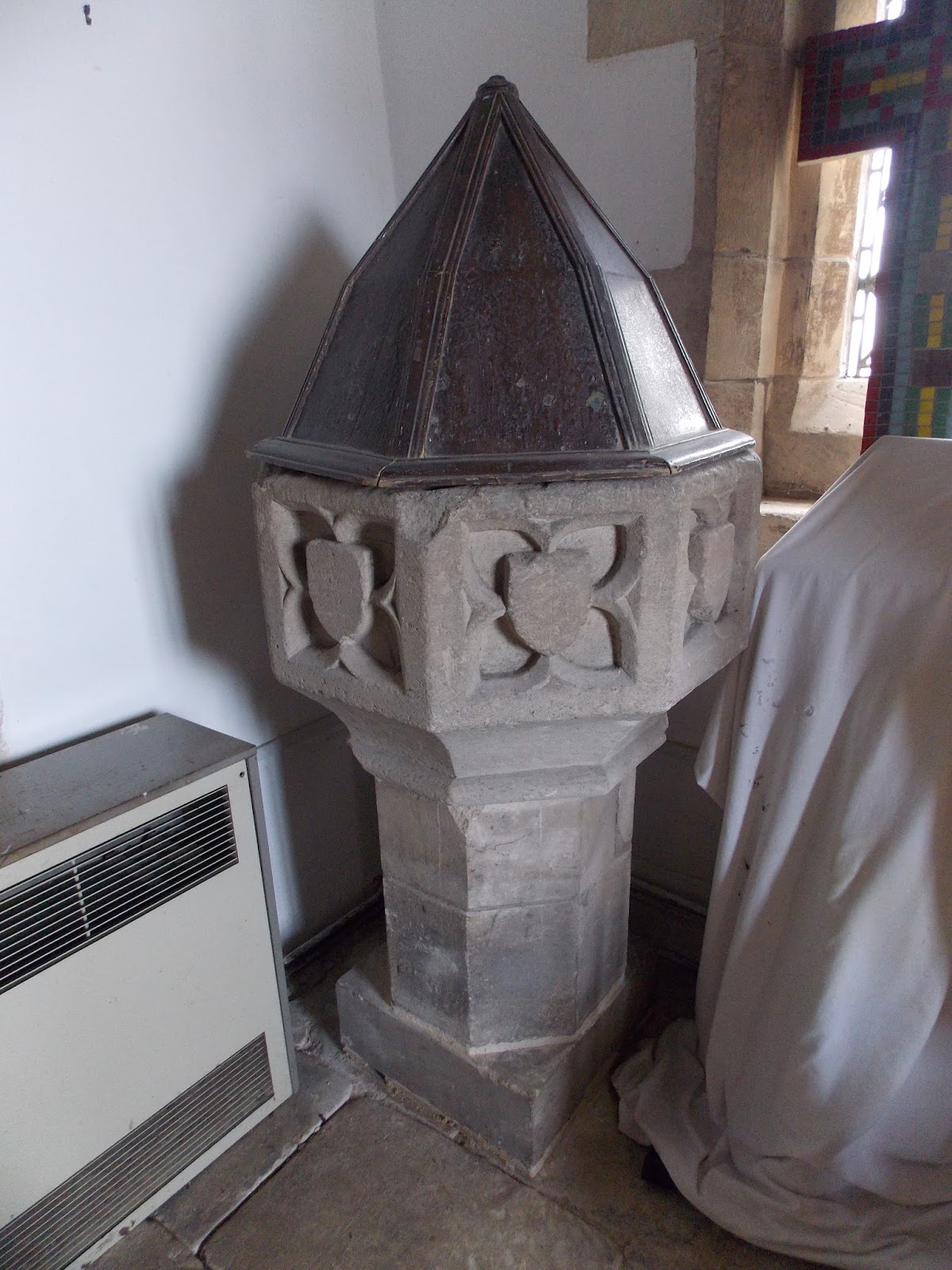
In St. Denys, there are two fonts, both octagonal. At the moment, one font is in the back of the church, and has a flat cover added in the 18th century. The stone font is said to be 14th century (during the reigns of Edward II and III and the visitation of the Black Death), with cusped square panels containing blank shields. Perhaps the shields were painted when new.
The "younger" font is still
600 years old.

The other font is 16th century (the reigns of Henry VIII, Edward, Mary, and Elizabeth), and has a conical wood cover. It is set in the corner of the north aisle near a heater. It has blank traceried panels and sunk spandrels, plain shields and quatrefoils to the stem. Quatrefoils look like four-leaf clovers and represent the four Evangelists of the New Testament: Matthew, Mark, Luke, and John. They also symbolize good luck.

One font would have belonged to St. Denys's church, and the other is from St. Peter’s church that had been closed in the late 1500s. The St. Peter's font was, according to an old historical account, "long used as a sink in a small farm house, but has now been rescued from such degradation and stands in front of the parish school-house as a reminiscence of the lost church." Update that to show that the font is now in the care of St. Denys church. 

There’s no way to know which was in use when William Dyer was baptized in September 1609, or his older brother’s and younger sister’s baptism. It's possible that the congregation leaned toward the Puritan faction of the Church of England. They believed in infant baptism, but Puritans may have altered the service from the Book of Common Prayer liturgy. Whether Puritan or CofE, we can imagine his father the churchwarden, (perhaps his mother, but not likely), the minister, the godparents, and the parish members standing in a circle around a font, saying the baptism service in the Book of Common Prayer.


And then the Godfathers, Godmothers, and people, with the children muste be ready at the Church dore…
DEARE beloved, forasmuche as all men bee conceyved and borne in sinne, and that no manne borne in synne, can entre into the kingdom of God (except he be regenerate, and borne anewe of water, and the holy ghost) I beseche you to call upon God the father through our Lord Jesus Christ, that of his bounteouse mercy he wil graunt to these children that thing, which by nature they cannot have, that is to saye, they may be baptised with the holy ghost, and receyved into Christes holy Church, and be made lyvely membres of the same.

Here shall the priest aske what shall be the name of the childe, and when the Godfathers and Godmothers have tolde the name, then shall he make a crosse upon the childes forehead and breste, saying.
Receyve the signe of the holy Crosse, both in thy forehead, and in thy breste, in token that thou shalt not be ashamed to confesse thy fayth in Christe crucifyed, and manfully to fyght under his banner against synne, the worlde, and the devill, and to continewe his faythfull soldiour and servaunt unto thy lyfes ende. Amen.

[More…]


Ceiling and roof
View of the chancel window and
wood ceiling over the nave.
In 1881, The Antiquary magazine said,
This church is in "a most lamentable condition," to use the words of the Bishop of Nottingham, the roofs in particular requiring prompt attention. 
 The architectural surveys I read never mentioned the ceiling of the church, but Roy Hackford’s photos show nicely finished rafters and joints that look to be in excellent and uniform condition, so they must have been rebuilt or restored.   

The roof consists of lead tiles over the chancel, and tile over the rest of the building. (That’s why it looks like there are two roof styles in exterior photos.)

Rood screen, stairs, loft
 The rood screen in St. Denys was carved wooden openwork stretching across the opening to the smaller chancel, from the nave. In medieval times, it may have been painted or gilded, with a crucifix of the Suffering Christ, and possibly small statues of saints (like St. Denys, for instance) or apostles. Its purpose was to separate the altar with its sacred objects from the non-clerical people. During the Lenten period, the rood was veiled, then revealed for Holy Week, when the Passion story was read to the congregation.


The 13th century rood screen is inside the tower.
It once separated the chancel from the nave.
The rood stair (in the north aisle) leads to the rood loft, a space that gave access for cleaning or veiling the rood screen. There’s a large niche high on the left wall of the chancel, which is the opening to the rood loft. In some churches (not St. Denys), the space was used instead as a hermitage.

The 13th century wooden screen is now installed at the tower arch at the rear of the nave. It seems to be used as a curtain rod to hide the opening to the tower. Many churches I’ve seen use the floor of the tower to store music, Sunday school materials, or cleaning supplies.

Most roods, whether stone or wood, were destroyed in the English Reformation iconoclasm and the Civil War a century later, but perhaps Kirkby La Thorpe was such a small parish that it was missed by soldiers.


William Dyer the landowner and churchwarden and his family have been obscured over time, except for the legacy to his remarkable son William, whose countless thousands of descendants are nearly all Americans.
The northeast view of St. Denys includes the blocked-up devil's door,
the north aisle, the buttresses that support the lead
roof, and the north side of the tower. Before the English Reformation,
the north side of the church was the undesirable place for burials.
Most people now wouldn't know that. But you do!

**********
Thanks from this author, and the thousands of modern friends and descendants of William Dyer, go to Roy Hackford, who generously agreed to travel from his home in Boston, Lincolnshire, to Kirkby La Thorpe, and take photos on a lovely spring day. He scanned the images and emailed them to me in high resolution, which meant that I could zoom in on certain features and crop them for this article.
Also, thanks to Rev. Valerie Greene, MA, the rector of St. Denys, for opening the church to Roy for photographs after I emailed her for permission. 


**********


Christy K Robinson is author of these books:
Mary Dyer Illuminated Vol. 1 (2013)  
Effigy Hunter (2015)  

And of these sites:  
Discovering Love  (inspiration and service)
Rooting for Ancestors  (history and genealogy)
William and Mary Barrett Dyer (17th century culture and history of England and New England)

If you enjoyed this study of a 1,000- to 1,400-year-old place of worship, you'll also enjoy Effigy Hunter, Christy K Robinson's five-star travel guide and handbook for the discovery of medieval burial monuments and places in UK and Europe. Said one reviewer:
"A must for medieval lovers."