Monday, September 25, 2017

Clothing fashions during the Dyers' lifetime--part 1

© 2017  Christy K Robinson 

This article is copyrighted. Copying, even to your genealogy pages, is prohibited by US and international law. You may "share" it with the URL link because it preserves the author's copyright notice and the source of the article. 
All rights reserved. This book or blog article, or any portion thereof may not be reproduced or used in any manner whatsoever without the express written permission of the author except for the use of brief quotations in a book review. 


This post is the first of two, on fashions of the early and mid-17th century, during the lifetimes of William and Mary Barrett Dyer and Anne and William Hutchinson. I tried to cover the various social strata, whose type of clothes were prescribed. For instance, shoe height had to be low for the poorer sorts, and gowns or men's boots had to match their station.

Since Mary and William Dyer were respected and in a higher merchant class, as well as William's social status as colonial attorney general, they wouldn't be wearing court dress of the aristocrats, but they'd be very well turned out with fabrics, colors, and ornaments like collars and hats.

When they moved from London to Boston, they probably wore more sober Puritan dress, but even so, it would have been of high quality, with laces and quality boots to show their status and educational level. But for some years, there were no riding horses or carriages, so most people, even Gov. John Winthrop, walked for miles in sunshine, rain, or snow.

When they moved to Rhode Island, they would have added clothing that would be practical for their farming and sailing activities, though they certainly would have had servants and laborers to do heavier chores than feeding poultry or milking goats. Of course, William would have had courtroom clothes (and possibly a wig), and Mary would have dressed plainly when she became a Quaker in the 1650s. Plain doesn't mean shabby, though--unless you think of living in the same clothes for weeks or months at a time while in prison. She was still expected to maintain a dress standard to honor her husband's social and professional status. There's no evidence that she was criticized for immodesty or dressing too poshly or poorly, so she must have found the right balance.


1. 1660s: Dutch woman reading (detail), by Pieter Janssens Elinga

2. ca 1600: Bartholomew family group--grandparents, parents, and children.
Two of the boys emigrated to Massachusetts as young adults.
I'm not sure, but this may be the Bartholomew family
who were friends with William and Anne Hutchinson
in London, but turned against Anne in Boston. Their clothes
indicate they were respected members of society, and the
deep black shows their wealth. (It was difficult to match black pieces,
and they tended to fade with cleaning.)

3. About 1615: Lady Arabella Stuart, falsely claimed to
be Mary Dyer's biological mother.

4. 1630: Four Figures at Table, by Louis Le Nain

5. 1620s-30s: Netherlands Family Making Music, Molenaer

6. 1600s- Cecelia, by Bernardo Strozzi

7. 1615-Frances Howard, Countess Somerset

8. In 1630 London, this was the suggested "look" for the
English gentleman. Click photo to enlarge, so you can
see the smaller images around the border.

9. 1630s: English satin evening dress.
This is how Queen Henrietta Maria dressed.

10. 1630s-40s: Country woman

11. 1630s-40s: Lady of the court

12. 1630s-40s: English dress with lace shawl collar, fur muff

13. 1630s-40s: English gentlewoman

14. 1630s-40s: English, modest dress and coif (woman's cap)

15. 1630s-40s: English, modest dress and coif

16. 1630s-40s: Merchant's wife of London

17. 1630: Helene Fourment in her wedding gown. She was married to
painter Peter-Paul Rubens.

18. The Jewish Bride, by Rembrandt van Rijn. This may be
a depiction of the biblical patriarch Isaac with his bride Rebekah,
but it shows how a bride would dress in 17th-century Netherlands.
In fact, author Donald Michael Platt discovered that the male model
for this painting was Vicente Rocamora, the subject of his historical novels!

19. Anabaptist family, suppertime. Unknown year and country.

20. 1630s-Queen Henrietta Maria of England.
Note the crown near her left hand.

21. 1630-35: Family group in a landscape, England

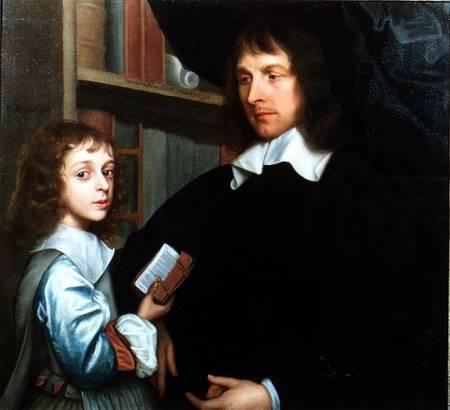
22. 1647- Portrait of Lady Mary Fairfax (1638-1704), aged nine,
with her tutor, by Robert Walker (1607-60).  Lady Mary
was the daughter of General (Lord) Thomas Fairfax of the English Civil Wars.
The girl went on to become Lady Mary Villiers, Duchess of Buckingham.

23. 1630s-woman's shoe height related to societal status

24. 1633: Henrietta Maria of France, Queen consort of England.
A Catholic, she dressed more modestly than many Anglican
and Puritan women of her time.


Part two of two on this subject coming soon!
************************************

Christy K Robinson is author of these books:

We Shall Be Changed (2010) 

Mary Dyer Illuminated Vol. 1 (2013)   

Mary Dyer: For Such a Time as This Vol. 2 (2014) 

The Dyers of London, Boston, & Newport Vol. 3 (2014)  

Effigy Hunter (2015)   

Anne Marbury Hutchinson: American Founding Mother (2018)


And of these sites:  

Discovering Love  (inspiration and service)

Rooting for Ancestors  (history and genealogy)

William and Mary Barrett Dyer (17th century culture and history of England and New England)


Friday, September 15, 2017

Autographed books on Mary Dyer, less expensive than Amazon!


Limited number of author-signed books now available!
  I have available 10 (now only three, so hurry and order!)  two-volume sets of my biographical* novels, Mary Dyer Illuminated and Mary Dyer: For Such a Time as This, that I will personalize for you or your gift recipient.

The retail (unsigned) price on Amazon is $20 each, plus shipping. But I will sign and ship them to US addresses as a pair, for $36 postage paid.

 The story is told in two volumes because having researched Mary Dyer for years, I couldn’t write her story without her extremely remarkable husband, William Dyer. No one has written of his accomplishments until I did, perhaps because he was overshadowed by Mary’s famous death.

At the end of the second volume, there’s a nonfiction section that ties off the stories of all the characters and the Dyer children, and discusses what happened after Mary’s execution on the Boston gallows in 1660.

Additionally, there are 13 copies of a companion volume, the nonfiction The Dyers of London, Boston, & Newport, that I will sign and mail to US addresses for $14.

And my book Effigy Hunter, which is a gallop through abbeys, priories, and country churches of England and France (and a few European countries) in search of stone or brass effigies of your medieval ancestors, is also available for signing. I have five copies in stock. For a description and reviews, see http://bit.ly/EffigyHunter .

If interested, please leave your name in my website contact form (<--click link) and I’ll email and then invoice you through PayPal, allowing you to pay securely with a bank card or from your checking account. 

HURRY! I only have these few books on hand, and they go first-come, first-served.

 ***** 

*What is a biographical novel?  Among my author colleagues, it's defined as a book that's been researched as a biography, but with dialogue and scenes included (necessarily called fiction), and some deep thinking about what motives passed through our subjects' minds that moved them to their larger-than-life events. The 1994 book, Mary Dyer, Biography of a Rebel Quaker, by Ruth Plympton, was a biographical novel, in that she speculated on a number of events and included the notion that Mary Dyer was the child of royalty--which had been soundly refuted by historians 50 years before Plympton dredged it up again.


In the case of these Mary Dyer novels, I researched hundreds of modern and 17th-century books, medical papers, epidemiology, astronomy, climate and weather, John Winthrop's books, journals and letters of the time, tavern ballads, the theology position papers of John Cotton and Roger Williams, the court records of Anne Hutchinson's trials, short genealogies of every character, English and Dutch maps of the era, information on the Native Americans around Narragansett Bay, the culture of white, Native, and African slavery, the records of the English secretary of state and spymaster, and many other fascinating documents--and then wrote Mary's and William's story without it being an info-dump, or for the villains to be flat cartoons instead of fleshed-out human beings. 

Thank you for your support! 
Christy K Robinson

Christy K Robinson is the author of the books:

Mary Dyer Illuminated Vol. 1 (2013) 
Effigy Hunter (2015) 
Anne Hutchinson, American Founding Mother (2017)

Tuesday, September 5, 2017

Big respect for a departed friend, Carolina Capehart

I was saddened to learn today of the passing of a friend of several years, Carolina M Capehart.
Carolina Capehart, my friend because we both
love history, and came together because of
this Dyer blog. Rest in peace.


Carolina was a food historian and hearth-cooking expert, who could be relied upon for good advice in research and writing on foods, menus, and cooking in the 17th-19th centuries. I sometimes consulted her for my Dyer research and for this blog.

Over the seven years I knew her online, she was a frequent presence on the Mary Barrett Dyer profile, and she commented often in this blog.

I tried to convert her to the joys of green chilies, even mild ones, but she would have none of it. There was no way she'd adulterate her corn pudding with a nice, juicy pasilla or Anaheim diced in.

"I'm pretty much stuck in my ways," she said. "Besides, I'm too old to start experimenting now! LOL oy."

Carolina said "LOL oy" a lot. It was like she’d hit her funny bone on the table. She also ruefully cussed with "Dagnabbit."

Carolina was an actress in her youth, and as an adult was a historical reenactor or interpreter. She taught hearth-cooking and fed samples to countless thousands of people in historical houses or battlefields, Colonial Williamsburg, and other places.

She wrote to me, “I always follow a recipe from an historic cookbook. The other thing is...I don't cook...as in modern cooking...it's Stouffer's frozen entrees for me! Or 5 Guys. Or KFC popcorn chicken. Maybe a steak now 'n then. YUM! The only way to go. I may render my own lard, but I sure ain't gonna spend much time cooking my own meals.”

She passed away in April 2017.

Her friends don't know why she passed, and might never learn, for her Christian Science denomination doesn't talk about illness and death, and there's no post from a relative on her Facebook page. I had messaged her and didn't receive an answer, but assumed she was taking a break from Facebook.

If you have an interest in historic cookery, visit Carolina's blog. She was an excellent writer (don't judge by our informal messages above). https://firesidefeasts.wordpress.com/about/

So as you think about your ancestors and how they might have lived, how they cooked and what they ate, think kindly of Carolina and remember her.


*****
Here's an article on Carolina and her work: http://www.brooklynpaper.com/stories/31/26/31_26_vintage_victuals.html 

Thursday, August 31, 2017

The Great Frost of 1608

Copyright 2017 Christy K Robinson
This article is copyrighted. Copying, even to your genealogy pages, is prohibited by US and international law. You may "share" it with the URL link because it preserves the author's copyright notice and the source of the article. 

I have been researching and writing a nonfiction biography about Anne Marbury Hutchinson.  Someone who negatively reviewed one of my Dyer books complained that some of the articles were taken from this Dyer blog, which costs me thousands of hours in research and writing time, and money spent on research books--but is provided at no cost to readers. With that sort of critical attitude, I decided to remove or heavily edit some of the articles from this blog, to make my books even more exclusive than they had been. "The Great Frost" is one of those articles. 

In this era when publishing companies and print periodicals have gone out of business, it's silly to dismiss websites and blogs as being wildly speculative or unsupported opinion. I know scores of historical authors and researchers who will agree with me that blogs are legitimate sources of research, infotainment, and newly discovered fact, as well as corrections to fanciful antiquarians of the 18th and 19th centuries.

When I researched the Dyer books, I read literally hundreds of books and scholarly papers about their culture, beliefs, and practices, spoke with experts and scholars, and I visited the places I was writing about.

In the Hutchinson book, there's a very long bibliography at the end. This article, excerpts of a chapter of the Hutchinson book, is about an event that took place when Anne Marbury (not yet Hutchinson) was a teenager living with her family in London. Her father was a popular minister and had authority over several churches at the time.


The Great Frost
excerpts from the book,  
Anne Marbury Hutchinson: American Founding Mother
© 2017 by Christy K Robinson
 
T
he Great Frost of 1608 began in December 1607, when a massive freeze descended on Great Britain, Iceland, and Europe. It enveloped city and country alike, freezing animals and people, stopping trading ships, sending icebergs on the North Sea between England and the Continent, and freezing seaports so that coastal shipping trade came to a stop for three months. 

“The first decade of the 17th century was marked by a rapid cooling of the Northern Hemisphere, with some indications for global coverage. A burst of volcanism and the occurrence of El Niño seem to have contributed to the severity of the events. … Additional paleoclimatic, global evidence testifies for an equatorward shift of global wind patterns as the world experienced an interval of rapid, intense, and widespread cooling.”
Schimmelrnann, Lange, Zhao, and Harvey,  abstract,
 
The Peruvian silica volcano, Huaynaputina, erupted in 1600, with so much ejecta that more than 12 cubic miles of rock and ash filled the atmosphere, causing rapid global cooling and catastrophic weather events for a decade, including a Russian famine that killed two million people, epic mud flows in California, great droughts and freezes that affected the Popham and Jamestown colonies in Virginia, and die-offs in European vineyards. The far-off Peruvian volcano affected Great Britain, too.

Perhaps to profit from the phenomenon of a once-in-a-lifetime cold spell, an anonymous author wrote a 28-page book, The Great Frost: Cold doings in London, except it be at the Lottery, With newes out of the country. A familiar talke betwene a country-man and a citizen touching this terrible frost and the great lotterie, and the effects of them. the description of the Thames frozen over, which may have a longer title than the interior text. The cover says it was printed on London Bridge (then supporting shops and tenements above the shops), so undoubtedly the book was meant to be sold on the frozen river below. There were two characters, the Countryman and the Citizen, having a dialogue about the first Frost Fair ever held, and the economic conditions of England because of the extended freeze.

         In the city, the Frost Fair meant that shops could set up market tents on the frozen river that “shows like grey marble roughly hewn” and sell souvenirs and winter clothing and shoes, serve alcohol from bars on wheels, gamble on sports or animal baiting, provide hot fair food from fires built on the ice (I wonder if they deep fried odd things as we do now), and have sleigh rides up and down the river. Ice skating was well-known in the Netherlands and Germany, and perhaps the English tried it. They also played football, and shot arrows and muskets. The Citizen said: “Both men, women, and children walked over, and up and downe in such companies, that I verily believe, and I dare almost sweare it, that one half (if not three parts) of the people in the Citie, have been seene going on the Thames.” 

And right there in London, probably out on the ice on a Saturday, we’d find the Marbury family, listening to musicians and watching dancers, playing, and eating fair food like turkey leg, meat or fruit pies, and gingerbread. 

A man golfing on ice, whose clothing style
 puts him in this time frame. Some avid golfers
will tell you that their sport of chasing
a little ball is silly in the best of summer
weather—but this man is very determined
to improve his game.

With little or no firewood or coal, people shared beds, mixing up aunties and grandchildren, parents and babies, servants and any guest staying the night. They had cupboard beds or four-posters with a canopy and curtains to keep their body heat and warm breath captive. The large Marbury family would have shared beds and body heat at night.


         With commercial traffic stopped in its tracks during the Great Frost, the merchants, warehouses, dock hands, ship crews, and others were forced into stoppages they called “The dead vacation,” “The frozen vacation,” and “The cold vacation.” We can imagine the effect on their economy, especially if they were living hand to mouth. 

         Coupled with the loss of work and little to sell in the shops, the price of food rose precipitously. “For you of the country being not able to travel to the City with victuals, the price of victail [victuals, food] must of necessity be enhanced; and victail itself brought into a scarcity,” wrote the Citizen.

The church poor rolls, the parish charity for widows and orphans, would have been stretched past their limits when they experienced weather and epidemiological catastrophes, so of course the Marburys would have been no stranger to hard work, short rations, and sharing small spaces.

The Great Frost was harsh, and it wasn’t the only time the Thames froze, but it was the most memorable. It lasted a little more than three months until the ice broke up and life returned to normal. Well, normal for them. Warmer meant…

Table from page 49 of
Schimmelrnann, Lange, Zhao, and Harvey,  abstract,
http://aquaticcommons.org/14822/1/Arndt%20Schimmelmann.pdf
that gives extreme climate events in the early 1600s.

 Click image to enlarge.
 

 ************* 

Christy K Robinson is author of these books (click the titles): 

Mary Dyer Illuminated Vol. 1 (2013)   
Effigy Hunter (2015)   

And of these sites:  
Discovering Love  (inspiration and service)
Rooting for Ancestors  (history and genealogy)
William and Mary Barrett Dyer (17th century culture and history of England and New England)

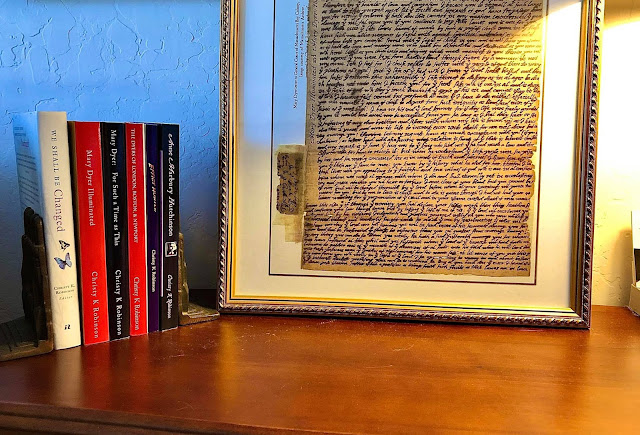
Books by Christy K Robinson, with a framed print of Mary Barrett Dyer's handwritten letter to the General Court of Massachusetts Bay Colony, October 1659.

Saturday, July 22, 2017

The new church and the pastor's battle with a chicken

Enjoy this guest post, a slice of life in 1682 New England.
© 2017 Ken Horn

Those old, stern Puritans. I love to study them. And because they are my ancestors, and some of my forebears experienced persecution at the hands of their ministers and leaders, I love to criticize them. But Puritan clergy were not always the staid, stern destroyers of all that might be enjoyable.

Old Tunnel Meeting House, Lynn, Mass., 1682.
Notice the signature of "Jeremiah Shepard," the hero of
this story.
Photo: Digital Commonwealth, Massachusetts Collections Online
I came across a delightful account of a feast given at the dedication of the Old Tunnel Meeting-House in Lynn, Mass., in 1682:
"Ye Deddication Dinner was had in ye greate barne of Mr. Hoode which by reason of its goodly size…. Ye kine [cattle] that were wont to be there were forced to keep holiday in the field."

Kine "forced to keep holiday in the field." Better than
being on the menu!
Photo: Colonial Williamsburg
 Though the cows were out and the place had been swept and cleaned, it appears that “the fowls persisted in flying in and roosting over the table, scattering feathers and hay on the parsons beneath.” The writer was apparently too delicate to mention what else they might be scattering on the parsons and the table beneath.

The sitcom begins when a Reverend Mr. Shepard runs afoul of a fowl: 
The fowl might have been upset at the loss of a family
member or two, for purposes of the meal.
"Mr. Shepard's face did turn very red and he catched up an apple and hurled it at ye birds. But he thereby made a bad matter worse for ye fruit being well aimed it hit ye legs of a fowl and brought him floundering and flopping down on ye table, scattering gravy, sauce and divers things upon our garments and in our faces. But this did not well please some, yet with most it was a happening that made great merryment.”

The banquet ended with some "mawdlin songs and much roistering laughter."

The account ends: "So noble and savoury a banquet was never before spread in this noble town, God be praised."

Indeed. One wonders how long it took for townfolk to pass by the unfortunate Rev. Mr. Shepard without snickering. And this would surely come to mind every time the poor parson preached.


****** 
Rev. Jeremiah Shepard, 1648-1720, was the son of Thomas Sheperd, one of three inquisitors of Anne Marbury Hutchinson while she was incarcerated in Joseph Weld's home in Roxbury during the harsh winter of 1637-38.

For more on Rev. Jeremiah Shepard, who was a strange bird himself, see Wikipedia.

Also see the 1905 book, Life of Rev. Jeremiah Shepard: Third Minister of Lynn, 1680-1720,  by John Joseph Mangan.  Rev. Shepard was accused of wizardry in the Salem witch trials and narrowly escaped trial and imprisonment.


******
Dr. Ken Horn is a minister and author, a history-loving descendant of Anne and William Hutchinson and William and Mary Dyer, and lives in Springfield, Missouri.

Tuesday, July 18, 2017

Holden, Gorton, Greene, and the Rolling Stones


© 2017 Christy K Robinson

This article is adapted from a chapter in my book manuscript on Anne Marbury Hutchinson.

R
andall Holden was one of the Rhode Island men abducted in 1643 by the Massachusetts Bay Colony. He wrote a long, angry letter to the General Court from his prison cell in Salem.

            Holden, 41, Samuel Gorton, 51, and John Green, 49, and other men had been supporters of Anne Hutchinson, and shortly after founding Pocasset/Portsmouth, had moved to lands they purchased in January 1643 from the sachem Miantonomo at Shawomet, now called Warwick, Rhode Island. It was land falsely claimed by Massachusetts Bay Colony, based upon a fraudulent charter that Rev. Thomas Weld, an agent and envoy of the Bay, was sending around to important government figures for their signatures, as if they’d approved it in Parliament.

In the letter, Holden called Gov. Winthrop and the Court the “Idol General” and “Judas Iscariot’s fellow confessor for hire,” and he’d heard that Winthrop had said that either the Rhode Islanders (Holden, Gorton, and Greene, Robert Potter and Richard Waterman) would be subjected to him or removed to Boston, “though it should cost blood.”

Warwick to Boston via I-95.
Google Maps
They’d been summoned to Boston and given words of safe conduct, but when they’d ignored the summons, they’d been violently abducted by a 40-man force, beaten, and imprisoned in several Massachusetts Bay towns, with iron fetters on their legs to prevent escape. They were not charged or tried on their possession of the disputed land, but on new charges of sedition and heretical religious beliefs—the same charges Anne Hutchinson had faced six years before. Their conviction was a foregone conclusion, and they were put to hard labor on nearby farms, still shackled. But they were saved from execution by only two votes of the General Court. Gorton, a fiery-tempered man in those years (though he later mellowed and was a credit to Rhode Island), was warned that if he should speak or write of his blasphemous and abominable heresies, he’d be condemned to death and executed. Holden, Greene, and the others were similarly threatened with death if they spoke to anyone but an officer of state or church. They were “silenced.” After a winter at hard labor, they were banished upon pain of death, both from Massachusetts Bay and from their homes at Shawomet.

Randall Holden’s letter had a long passage that accused the MassBay government of knowing Anne Hutchinson’s move to Pelham, where she and much of her family were massacred, had been preventable, but they said nothing, making them complicit in the deaths.

Holden, Greene, and Gorton went to England in 1644 to resolve their grievance and get a charter from the Earl of Warwick, a Puritan who was an overseer of colonies in the western hemisphere. The three Shawomet men had to sail from New Amsterdam (New York City) because of the animosity of Boston’s authorities. They were successful in their quest, but the King was executed in 1649, which meant that Rhode Island needed a new charter in 1650-51, when William Dyer was the colony’s attorney general.

* * * * *

Jagger and Richards on the American
Tour in 1972.
Wikipedia
 So what brought this story to mind? I learned from a post by New England Historical Society that on July 18, 1972, Rolling Stones musicians Mick Jagger and Keith Richards were in jail in Warwick, Rhode Island (formerly Shawomet, remember), for messing with drugs and scuffling with a photographer. (I know this drug connection comes as a shock to you, right?)

But over in Boston, 15,000 Rolling Stones fans were short on “Satisfaction,” and eager to rock out at a Stones concert at the Boston Garden. The Boston mayor, Kevin White, was concerned that a riot would break out if the Stones didn’t roll in. This was a distinct possibility, considering previous violence at concerts around America that summer. He persuaded Rhode Island police to release the criminals into his custody, and Massachusetts police, using lights and sirens, rushed the rockers up I-95 to Boston, where opening act Stevie Wonder had played the longest warm-up set of his career. At 1:00 a.m., the Stones arrived at the venue and performed their concert, while the mayor arranged with the transit authority to keep running so concert-goers could get home.

For comments from people who attended the concert, see this Facebook link: https://www.facebook.com/NewEnglandHistoricalSociety/photos/a.150432615140239.1073741826.149729011877266/722370191279809/?type=3&theater
Massachusetts State Police car, 1972

The parallels between 1643 and 1972 are not very close, but it’s fun to compare the Warwick-Boston relationship! This is why we enjoy history, right?


* * * * *

Christy K Robinson is the author of this Dyer website and three five-star-reviewed books on the Dyers, available by clicking these links.

·          We Shall Be Changed (2010)
·          Mary Dyer Illuminated (2013)
·          Mary Dyer: For Such a Time as This (2014)
·          The Dyers of London, Boston, & Newport (2014)
·          Effigy Hunter (2015)
·          Anne Marbury Hutchinson: American Founding Mother (2018)