Sunday, January 20, 2013

Mary Dyer at Shelter Island: She ever shined in the image of God

Guest post © Johan Winsser

Shelter Island (marked) in relation to New England
 After spending the winter of 1659-60 witnessing to her faith on Long Island, Mary Dyer went in the early spring to Shelter Island, thinking to go from there back to Rhode Island. About seven miles in breadth and width, Shelter Island lies between the two peninsulas at the eastern end of Long Island. It was largely owned by Captain Nathaniel Sylvester, one of four wealthy Barbados sugar planters who in 1651 purchased the island from New Haven Colony, intending it as a station for their flourishing triangular trade between England, the West Indies, and New England.[1] Objections to Sylvester’s Quaker sympathies—his close business partner was the Quaker Colonel John Rous and he was married to the sister of William Coddington’s third wife—were not so strong as to bar him from carrying on a profitable commerce with the merchants of New Haven Colony.[2]

Sylvester Manor, Shelter Island
Photo courtesy of Johan Winsser

At Shelter Island, Sylvester gave succor to traveling and expelled Friends. Lawrence and Cassandra Southwick of Salem came to the island in the summer of 1659 after their harsh treatment at Boston. Being elderly and in frail health, Lawrence made his will and died there the next spring. His wife and yokefellow Cassandra followed three days later. William Robinson, who would die for his faith and principles on the Boston gallows in October 1659, was appointed one of the two overseers of Southwick’s will. No tombstones were erected for the Southwicks—not surprising since early Friends usually did not erect memorials to the dead, giving no nod to worldly vanity.

Quaker cemetery, Shelter Island
Photo courtesy of Johan Winsser
 In 1884 a four-sided monument to the early Friends who had visited the Island was erected in a quiet grove. Each step was inscribed as follows:

West Top Step – THE PURITAN AND HIS PRIDE
West middle step- OVERCOME BY THE FAITH OF THE QUAKER
West bottom step – GAVE CONCORD AND LEXINGTON AND BUNKER HILL TO HISTORY

South top step – DANIEL GOULD BOUND TO THE GUN CARRIAGE AND LASHED
South middle step – EDWARD WHORTON THE MUCH SCOURGED
South bottom step – CHRISTOPHER HOLDER THE MUTILATED

East top step - LAWRENCE AND CASSANDRA SOUTHWICK
East middle step- DESPOILED IMPRISIONED STARVED WHIPPED BANISHED
East bottom step- WHO FLED HERE TO DIE

North top step – OF THE SUFFERINGS OF CONSCIENCE SAKE OF FRIENDS OF NATHANIEL SYLVESTER MOST OF WHOM SOUGHT SHELTER HERE INCLUDING
North middle step - GEORGE FOX FOUNDER OF THE SOCIETY OF QUAKERS AND OF HIS FOLLOWERS
North bottom step - MARY DYER MARMADUKE STEVENSON AND WILLIAM ROBINSON WILLIAM LEDDRA WHO WERE EXECUTED ON BOSTON COMMON
Zoom on northeastern part of Shelter Island, from Google Maps.
Quaker cemetery is close to head of Gardiners Creek.

When Dyer arrived, she found other Quakers already there and was warmly received. Like Elijah sojourning on the mountain before returning to confront Ahab, she decided to stay, to rest and reflect, waiting for the next clear command from God. A young Quaker, John Taylor, noted her arrival in his journal.

And there came several Friends from other Parts in New-England, to see us: One was Mary Dyer … She was a very Comely Woman and a Grave Matron, and eve[r] shined in the Image of God. We had several brave meetings there together, and the Lord’s Power and Presence was with us Gloriously.[3]

By May, as the days warmed, the osprey nested, the dogwood bloomed, and the gardens brightened with daffodils, lupines, and sweet peas, Dyer’s clear call had come. Her unwanted gallows reprieve last October enabled the Bay magistrates to avoid the only two choices she hoped to press upon them: repeal the bloody anti-Quakers laws or hang Mary Dyer. Furthermore, the reprieve allowed the magistrates another opportunity to dissemble about the Quakers. Any appearance of backing down from the tyranny of the Boston magistrates and ministers meant that the Quaker cause would be compromised. Dyer believed she had no choice but to go forward and put her life on the line again. Nothing less than a full revocation of those “bloody laws” could stay her course and spare her life.


__________________________
Johan Winsser has been researching and writing about Mary Dyer for many years. Some of his research is found on his DyerFarm website. Thank you, Johan, for your contributions to Dyer genealogy research, and to this Dyer blog.


[1] Helen Wortis, Shelter Island and Barbados,” Long Island Forum, [35:12] December 1972, 258-263.
[2] Isabel Calder, The New Haven Colony, New Haven, 1934, 97.
[3] John Taylor, An account of some of the Labours, exercises, Travels, and Perils, by SEA and LAND, of John Taylor of York: and also His DELIVERANCES; By way of Journal. London: J. Soule, 1710, 8.

Sunday, January 6, 2013

Puritan baby names of the 17th century


© 2013 Christy K Robinson

A baby-christening party, 1629, Flemish.
The mother lies recovering in the cupboard bed
at the rear, where two women are holding a baby in white.
 In Western culture, we know people with virtue names such as Hope, Faith, Irene, Zoe, and Joy, and those with biblical names like John, David, Jacob, Esther, Naomi, Mary, and scores of others. From ancient times, parents all over the world have named their children with religiously-significant meanings or prophecies in mind, names that would be something to live up to, names that could form a child's character and destiny. Many named their babies after kings, queens, and nobility, or after parents and other family members.


I christen thee "Flee-Fornication"
and thy twin, "Sorry For Sin."
William and Mary Dyer named their children in this manner. William’s father was William, Mary’s brother was William (which means her father was probably William), and they named their firstborn William. He died within a day or two of birth, and a later son was named William—that one, at age 18, bore the news of Mary's reprieve of execution in 1659, and later was mayor of New York. They named one son Samuel (“Asked For”), another son Charles after the recently-executed king, another son Henry (probably after Sir Henry Vane), a daughter Mary, and a son Mahershallalhashbaz. Oh, yes! It was shortened to Maher, but the name was bestowed based on Isaiah 8:4, after the death of their friend and mentor, Anne Hutchinson.

Only in the last few hundred years have children been named for popular figures or in an attempt to make unique sounds or word combinations. 

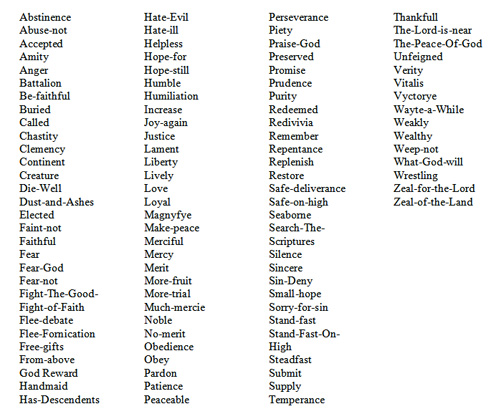
In the late 16th and throughout the 17th centuries, the Reformation gained ground in England, and splintered further when non-conformists insisted on “purifying” the Church of England. There was a large pocket of Puritans (as one branch of non-conformists was known) in Essex, and they tended to name their children with virtue names. I found a list of jury men in a PDF, with given names, followed by a comma and their surnames.

That's right, a grown man had lived his life thus far with the name, "Kill Sin Pimple."
 Thousands of Puritan emigrants to New England came from Essex, including Governor John Winthrop of Massachusetts Bay Colony. So many of them left England with money and possessions that the government of King Charles I believed that the English economy would fail. Eight ships were stopped in the River Thames in 1634, and the emigrants were prohibited from leaving. Among the passengers was Oliver Cromwell, bound for Connecticut—who would make war on the royalists in less than 10 years, and have King Charles beheaded in 15 years.

The Puritans of England and America—self-described as the Remnant or Elect in the book of Revelation— thought that the “world” was evil and they were living in the last days (indeed, deadly plagues and famines, religious wars, economic depression, and vicious crime regularly swept Europe), and Jesus would come in his second advent, in their lifetime, to take them to heaven and destroy the earth. Some of their names reflect that apocalyptic expectation: Return, Hope For, Redeemed, The-Lord-is-Near, and Wayte-a-While. Most of the Puritan emigrants to New England believed that the civilization they’d build would be a New Jerusalem, and these faithful ones would be hastening the Second Coming with their passion for perfection in keeping Old Testament laws. That was the reasoning behind the marriage of civil and ecclesiastical (blend of state and church) law. It wasn’t enough to live the sanctified life oneself. Oh, no. They were part of a larger community, and the entire community must conform to the law, or God would withhold his blessings, leave them in the dust, and rain down curses. A familiar story in this decade, don’t you think?

Church members were encouraged to report those who didn’t conform, or those who spoke against authorities, which was considered sedition. Hate-Evil, Obedience, and Zeal-for-the-Lord might be appropriate names given by families who believed that. The charge of sedition (for signing a mild remonstrance against the governor and assistants) prompted punishment and exile for about 75 families, including William and Mary Dyer and Anne and William Hutchinson. They purchased Aquidneck Island (later Rhode Island) from the Narragansett Indians and founded Portsmouth in 1638 and Newport in 1639. Massachusetts Puritans scornfully referred to the new colony as the Isle of Error or Rogues Island.

Most of the awkward names faded away with the English Civil Wars, replaced by virtue names such as Purity, Patience, and Faith. The vast majority of names we find in colonial archives and genealogies are what we’d consider “normal” names: names we still use 400 years later.


More great anecdotes about mid-17th century England and New England, supported by research, can be found in the nonfiction book The DYERS of London, Boston, & Newport, by Christy K Robinson. It's the third in a series about Mary Dyer, Anne Hutchinson, Sir Henry Vane, Roger Williams, and John Winthrop.


Christy K Robinson is author of these books:
Mary Dyer Illuminated Vol. 1 (2013)  
Effigy Hunter (2015)  

And of these sites:  
Discovering Love  (inspiration and service)
Rooting for Ancestors  (history and genealogy)
William and Mary Barrett Dyer (17th century culture and history of England and New England)
Editornado [ed•i•tohr•NAY•doh] (Words. Communications. Book reviews. Cartoons.)

Wednesday, January 2, 2013

In the tempest, power


Ada Bottesfordian, 1951.
18 Winter Street.
George Fox on Winter  

"And Friends, though you may have tasted of the power and been convinced and have felt the light, yet afterwards you may feel winter storms, tempests, and hail, and be frozen, in frost and cold and a wilderness and temptations. Be patient and still in the power and still in the light that doth convince you, to keep your minds to God; in that be quiet, that you may come to the summer, that your flight be not in the winter. For if you sit still in the patience which overcomes in the power of God, there will be no flying. For the husbandman, after he hath sown his seed, he is patient. For by the power and by the light you will come to see through and feel over winter storms, tempests, and all the coldness, barrenness, emptyness. And the same light and power will go over the tempter’s head, which power and light were before he was. And so in the light standing still you will see your salvation, you will see the Lord’s strength, you will feel the small rain, you will feel the fresh springs . . ."


Thanks to the Hay Quaker blog by Ray Lovegrove, for this lovely quote and provision of the artwork. 

George Fox, 1624-1691, was founder of the movement Society of Friends, which came to be called Quakers. Mary Dyer was "convinced" of their beliefs in the 1650s, and gave her life to stop the deadly persecution of Quakers in New England.

Wednesday, December 19, 2012

Oliver Cromwell Cancels Christmas


William and Mary Dyer were citizens of Great Britain who emigrated to New England in 1635 and co-founded the colony of Providence Plantations and Rhode Island in 1638. They were born during the reign of King Charles I, lived under Cromwell’s rule in the 1640s and 1650s, and after Mary died in 1660, William lived during the reign of Charles II.

Guest post © 2012 by Sarah Butterfield, used by permission
Originally published on Sarah’s History, 18 December 2012

“It’s only seven sleeps until Christmas Day!” was my dawn chorus this morning. Tomorrow six, the next day five... My three children will be practically exploding with excitement on Christmas Eve as they go to bed full of anticipation for the wonderful day that lies ahead of them when they wake up in the morning. Christmas Day is, for those that celebrate it, a day of present exchanging, feasting and having fun. Imagine, then, if all of that was taken away.
Charles I triple portrait,
painted by Anthony Van Dyke

The Wars of the Three Kingdoms in seventeenth-century Britain were a desperately unsettling time for the common people, as were the events that took place before them. Charles I believed in his divine right to rule very passionately, ruling without parliament for more than a decade. He also taxed his people to breaking point; enforcing ship money in peacetime away from coastal areas was one of his more unpopular moves. His poor rule over England and Scotland was one of the many complex reasons civil war broke out between the crown and parliament in the summer of 1642. At the same time, a form of Protestant Christianity known as puritanism was on the rise. Puritans believed in the simplicity of faith. To them, Christmas (among other celebrations) was an unnecessary Roman Catholic tradition; they disapproved of celebrating the feast day, and the gluttony, frivolity and excess that came with. In 1642, dedicated puritan soldiers and members of parliament did not celebrate Christmas.

In 1643, the threat towards Christmas was more severe. The parliamentarian leaders had signed a treaty with the Scottish in the autumn, sealing themselves military support against the royalist army of Charles I. As part of this treaty, parliament promised to further reform religion in England, bringing the faith of England closer to that of Scotland. The Scottish had been practicing presbyterianism, another form of simple faith, as their national religion for several decades. In the late sixteenth century Christmas festivities had been stopped (save for a brief spell beginning in 1617 when James I reinstated them), and now England were expected to follow suit.
“Love one another: A Tub Lecture Preached”
by John Taylor, warned that
Parliamentarian puritans
were a threat to the
celebration of Christmas
in January 1643.

The English puritans followed the Scottish Presbyterian lead, treating Christmas Day in 1643 as a day like any other. Shops were opened and church doors closed. Puritan members of parliament went to work at the Houses of Parliament, leading where they expected subjects to follow. John Taylor’s satirical pamphlet ‘Tub Lecture,’ published earlier that year, had become a gloomy reality. Still, the civil war could have gone either way, and Christmas wasn’t legally banned—yet.

In 1644, the non-celebration of Christmas became more extreme again, as the feast day clashed with a puritan fast day. Members of parliament favoured the fast over the feast; remembering their own sins as well as the sins of their ancestors for indulging themselves during the twelve days of Christmas. Parliamentary power was ever increasing by this time, and Charles’ power slipping away.

Oliver Cromwell,
successful soldier,
parliamentarian and Puritan
 Christmas 1645 was equally, if not more solemn than that of the year before. In 1645, Oliver Cromwell and Thomas Fairfax had created their New Model Army. Their army was structured, disciplined and puritan in the extreme. In addition to these qualities the army was incredibly powerful, and all but destroyed Charles’ royalist forces during two crucial battles—Naseby and Langport—that summer. Charles was captured and handed over to the Parliamentarian army. Decisions were to be made about Charles’ status now, but one thing was sure in the minds of parliament; they had won the war. Charles would be their puppet ruler. Earlier in 1645, parliament had issued their alternative to the Book of Common Prayer, ‘The New Directory for the Worship of God’; the book did not mention Christmas at all. With the king defeated, Christmas was gone. It was noted that man could walk the streets on Christmas Day in 1645, and have no idea that it was a Holy feast day.

John Taylor published another
pamphlet in 1652, titled
“The Vindication of Christmas,”
supporting the continuing
celebration of Christmas.
 Still, England’s Anglican subjects did not want to give up Christmas without a fight. John Taylor published another pro-Christmas pamphlet, ‘Complaint of Christmas’, persuading his fellow Christian men to continue celebrating Christmas in defiance of parliament. This the people did, and more besides. On Christmas Day 1646 men celebrated as normal, and attacked local tradesmen who had opened their shops for business as if it were a normal day.

June 1647 saw an act pass through parliament. Christmas was now a banned celebration, and anyone caught celebrating could be lawfully punished. This act was highly unpopular throughout the country, and sparked the pro-Christmas riots that erupted all over the country on Christmas Day that year. Holly was hung in blatant defiance of the new law. Shops that were open for business were attacked and smashed to pieces and men were killed.

Shortly after Christmas Day in 1647, Charles I opened communication with the Scottish to free himself from captivity and rule in his own way again. This sparked a second English civil war between parliament and crown; this time, however, the conflict was short-lived and parliament enjoyed a decisive victory the following August. Christmas 1648 passed with Charles imprisoned and parliament in charge. In January 1649, Charles was tried, found guilty and executed for high treason against his country. The war was over, and Christmas was gone. The parliamentary ban of Christmas held fast, with Oliver Cromwell continuing the law after he was named Lord Protector of England in 1653. Of course, just because Christmas was banned didn’t mean people didn’t celebrate it. They just did so in secrecy.
Charles II: The king who brought back Christmas!

In September 1658, Oliver Cromwell died and was replaced as Lord Protector by his son, Richard. (Interesting move for a man who was against the hereditary monarchy, but that’s a moan for another day.) Richard was an unsuccessful Lord Protector, and the people of England decided they wanted a monarch after all. Charles II was recalled from exile and restored to the throne in 1660. He brought with him the restoration of Christmas, which was a hugely popular and successful move. Hurrah for Charles II! No wonder he was such a popular king.

__________________ 
Further Reading-

“The Rise and Fall of Merry England: The Ritual Year 1400-1700″ by Ronald Hutton, Oxford University Press, 1994.
“Cromwell: Our Chief of Men” by Antonia Fraser, Phoenix Books, 2008.

“The English Civil Wars” by Blair Worden, Phoenix Books, 2009.


PS: I know it wasn’t technically all Cromwell’s fault, I just thought that title sounded pretty cool.
_____________
Sarah Butterfield is a history student living in Derbyshire, England. Visit her blog, Sarah’s History, for her studies in English history.

Wednesday, December 12, 2012

Enlightened

This post was written for the Viriditas blog of Mary Sharratt, author of Illuminations: A Novel of Hildegard von Bingen, in a series on Light and Advent, December 2012. My article is an opinion piece on Light, not intended to tell the entire story or beliefs of Mary Barrett Dyer. The theological concepts are complicated and I've simplified them here.


© Christy K. Robinson
Mary Dyer sculpture at Boston.
Photo by Erik Pettee, used by permission.

If you know of Mary Barrett Dyer, perhaps it’s the memorial statue at the Massachusetts State House; or that she was the Quaker woman hanged in Boston in 1660.

Mary was born in London at the time the King James Bible was published, and was admired for her intellectual, spiritual, and physical beauty. She and William Dyer were married under Anglican liturgy at St. Martin-in-the-Fields, but in 1635, they emigrated to ultra-Puritan Boston in Massachusetts Bay Colony, and were immediately admitted to membership in the First Church. (Some people committed suicide because their membership was denied.) The Dyers had to conform to Puritan ways to be accepted so quickly. However, Governor Winthrop observed that Mary was “addicted to revelations.”

Mary became a disciple of Anne Hutchinson, a religious dissident who claimed that God revealed insights about scripture to her—a “weak-minded” (but highly-educated) woman. She pointed out that instead of trying in vain to earn salvation by perfectly keeping the law, believers were set free from eternal damnation by God’s grace. They could trust divine leading in their conscience, with no need for intercessors or interpreters.

But the Puritan theocracy believed if every man did as he pleased, all would be anarchy. After several ecclesiastical trials, the Hutchinsons and Dyers and about 75 Massachusetts families were exiled for sedition and heresy. They purchased Rhode Island from the Indians, and founded a new colony in 1638.

Mary visited England in early 1652, where she observed several new religious movements, including the Religious Society of Friends (Quakers). In some respects similarly to Anne Hutchinson, the Friends believed that Old Testament laws were obsolete, and had been replaced by God’s voice in the individual’s conscience, which was revealed during times of silent reflection and worship. They experienced God as Light and overwhelming Love, in contrast to the vengeful Judge who predestined only certain people for eternal life. Some of the scripture they quoted included:

  • God is light; in him there is no darkness at all. … If we walk in the light, as he is in the light, we have fellowship with one another, and the blood of Jesus, his Son, purifies us from all sin. 1 John 1:5-7.
  • Believe in the light while you have the light, so that you may become children of light. ~Jesus. John 12:36.
  • For you were once darkness, but now you are light in the Lord. Live as children of light.” Ephesians 5:8
In 1657, Mary returned to America, was accused of being a Quaker, and was cast into Boston’s prison for weeks before William Dyer learned of it and rescued her. Thus began three years of Mary’s repeatedly defying religious oppression to gain relief and freedom for the violently persecuted.

Quakers in New England were fined, beaten, branded, whipped with a knotted cord, banished, tied to carts and dragged from town to town, imprisoned without food or heat in winter, and banished “on pain of death” for their efforts and beliefs. Those severe persecutions only made them more determined to share the Light.

For supporting Quakers, Mary was arrested and imprisoned at least five times. Finally, she was sentenced to death. She wrote a letter to the General Court on the night before her execution date. “I therefore declare that in the fear, peace, and love of God I came … and have found such favor in his sight as to offer up my life freely for his truth and people’s sakes. If this life were freely granted by you, it would not avail me to accept it from you, so long as I shall daily hear or see the suffering of my dear brethren and sisters.”

Mary Dyer's handwriting: "Search with ye light of Christ in you..." 
Letter to the General Court, October 1659.
  
She believed that her death would be so shocking to the public that it would bring about the end of the severe tortures and repression of Quakers by the Puritan leaders. Many Puritans sympathized with and helped Quakers, and had begun to turn away from their harsh government. Fearing unrest, the court granted a reprieve when she was on the gallows. She was imprisoned in Plymouth two weeks later, spent the winter at Long Island, then deliberately returned to Boston seven months later—to obey God’s command, and commit civil disobedience by trespassing against her banishment order and providing aid to imprisoned Quakers.

She was again condemned to death, and was hanged on June 1, 1660. Because her vengeful former pastor offered a cloth to cover her face, I believe that the Light was strong on her countenance.

Mary’s sacrifice was successful. Her letters were presented posthumously to Charles II, who ended executions for religious offenses. Her husband and close friends had significant influence on the 1663 Rhode Island royal charter of liberties that granted freedom of conscience to worship (or not), and retained separation of church and state. The charter was a model for the US Constitution’s Bill of Rights, which has in turn been the beacon of light for constitutions around the world. 

The light shines in the darkness, 
and the darkness has not overcome it. John 1:5. 

Christmas, Advent, Puritan, Quaker, Light

Thursday, November 22, 2012

How the English colonists celebrated thanksgiving

© 2012 Christy K. Robinson

In 1630, the first ripples of the Great Migration brought small convoys of ships from England to Massachusetts Bay after ten to twelve arduous weeks at sea, where they prevailed despite adverse winds and stale and insect-infested food. These were the Winthop Fleet, named for their governor, John Winthrop, and they had left families, farms, and inheritance to found a New Jerusalem and usher in the Second Coming of Jesus Christ.

They fought winds and tides to sail south along the islands and shoals of Maine to Cape Ann, to find the Endecott party at Salem, who had sailed there in 1628-29 and were supposed to have built houses and planted crops for the 1630 emigrants. But what the Winthrop Fleet, who were hungry and sick, found when they reached Salem, was a village of miserable huts, its residents politely but alarmingly asking if the new arrivals had any food to share. Half the Endecott party were dead or dying, and now the Winthrop party began to die of fevers or scurvy. When they arrived in early July, it was too late to plow and plant for the autumn which came in August and the winter which would come in early October. The fleet staggered into harbor between late June and mid-August. Winthrop’s second son, Henry, had drowned in a river almost immediately upon arriving in Massachusetts in early July.

When a ship arrived safely at Cape Ann, John Winthrop wrote in his journal on Thursday, August 8, 1630, “We kept a day of thanksgiving in all the plantations.”  

On thanksgiving days, non-essential work and commerce was prohibited, and families and servants were required to attend church services for hours. It was a day for solemn, agonizing prayer and soul-searching to discover hidden sin and confess it, so that God’s wrath would be appeased and he would not withhold his blessing from his recalcitrant children.

Thanksgiving was not a feast day. It was a fast day. Thanksgiving was a day of sorrow, to repent, to turn away from a sinful, rebellious life and return to God’s grace. It wasn’t enough for an individual person to repent—they were the Church, the body of Christ, and repentance and atonement were important for the entire community. They didn’t conceive of “rugged American individualism” at this time. They were wed to Christ and one another. Unmarried people were not permitted to live alone—they were placed in families. Wilderness pioneers were up to no good. In Plymouth Colony, a family tried to build a farm out in the woods by themselves, but were brought back by court order to live in community for the good of all.  

There would have been feast days, too, for celebrating weddings and births, and harvests. But because they weren't connected to the historical events that you'll see below, they didn't make it into John Winthrop's historical journal. 

In 1630, the majority of the Winthrop Fleet arrivals stayed in Massachusetts, though they couldn’t be supported in Salem as hoped: they needed fresh water. They scouted on foot, and planted the Dudley group at Charlestown, and the Winthrop group nearby at Boston. Some of the intended colonists returned to England, but the passengers faced piracy, broken masts, and even greater privation on the way back to “Babylon,” which was experiencing another wave of bubonic plague.

The ones who stayed in America lived in dugout shelters, tents, and cabins that resembled stables—and this was during the Little Ice Age, when they experienced severe winters with frozen bays. They had few stored provisions, no grain, no vegetables or fruit.  The Plymouth colony (the Pilgrims) helped as they could, and the few Indians who hadn’t moved to their winter camps traded bits of Indian corn and venison, and dried fish. This season was the Starving Time.
Read the story of Gov. Winthrop's
founding of Boston, and the struggle
to survive, in Mary Dyer Illuminated.

http://amazon.com/author/christykrobinson  

On the 11th of February 1631, when “great drifts of ice” floated in Boston Harbor, a sentry spotted the Lyon, one of the ships of the Massachusetts Bay Company, lying at anchor nearby. The ship’s master had rushed home to England, filled up with foodstuffs, and sailed back across the dangerous North Atlantic in winter (almost unheard-of because of the severity of storms), to relieve the suffering at the Bay. 

John Winthrop wrote: “The poorer sort of people (who lay long in tents, etc.) were much afflicted with the scurvy, and many died, especially at Boston and Charlestown; but when this ship came and brought store of juice of lemons, many recovered speedily. It hath been always observed here, that such as fell into discontent, and lingered after their former conditions in England, fell into the scurvy and died.”

In other words, those who regretted leaving the comforts of Babylon for the privations of New Jerusalem, were more prone to disease and death. Scurvy is a wasting disease caused by lack of Vitamin C.

Winthrop’s Journal, Feb. 22, 1631: “We held a day of thanksgiving for this ship's arrival, by order from the governor and council, directed to all the plantations.”

On Nov. 2, 1631, the Lyon arrived again with important people, including the Winthrop family, Rev. John Wilson (who would baptize the Dyers’ son Samuel in 1635 and revile Mary Dyer at her execution), Isaac Robinson (son of the Pilgrim pastor, Rev. John Robinson), etc., and food to last them the winter. On Nov. 11, Boston held a day of thanksgiving.

Many times throughout the 1630s and 1640s, Winthrop wrote of holding fast days and thanksgivings. Ironically, when famine and disease came upon the Bostonians, the governor, magistrates, and ministers would call a fast day to confess the sins they and their neighbors must have committed to deserve all the disasters which befell them.

Thursdays were the days when people were required to attend church services for teaching, and when courts would schedule the punishment of sex offenders, thieves, and (ahem) church members who neglected regular attendance, with time in the stocks and/or public whipping. Mary Dyer’s first execution date, October 27, 1659, was a Thursday. Her two Quaker friends were hanged; she was reprieved. Then the people who had come to town for the “festival” went to church, no doubt to hear sermons and lectures related to the just judgments of God and the courts. Days of thanksgiving, called “public days,” were also set for Thursdays.

In 1636 and 1637, Massachusetts Bay and Plymouth Colonies had fought the Pequot War, which was less war than genocide and enslavement of a Connecticut tribe of Native Americans. Hundreds of Pequots were slaughtered and burned, and Plymouth’s governor, William Bradford, wrote this of one of the Indian villages :
“It was a fearful sight to see them thus frying in the fire and the streams of blood quenching the same, and horrible was the stink and scent thereof; but the victory seemed a sweet sacrifice, and they gave the praise thereof to God, who had wrought so wonderfully for them, thus to enclose their enemies in their hands and give them so speedy a victory over so proud and insulting an enemy.”

 So, back in Boston, the theocratic council set June 15, 1637, as “a day of thanksgiving kept in all the churches for the victory obtained against the Pequods, and for other mercies.”

Please pass the turkey, mashed potatoes and gravy. Oh—sorry. You’re fasting and repenting. Carry on, then.  


Christy K Robinson is author of the books:
·          We Shall Be Changed (2010)
·          Mary Dyer Illuminated (2013)
·          Mary Dyer: For Such a Time as This (2014)
·          The Dyers of London, Boston, & Newport (2014)
·          Effigy Hunter (2015)
·          Anne Marbury Hutchinson: American Founding Mother (2018)

http://www.amazon.com/Christy-K-Robinson/e/B004S7UTNE/ref=ntt_athr_dp_pel_1
 

Wednesday, October 31, 2012

The ghost ship of 1647

© 2012 Christy K Robinson

Replica early-17th-century merchant ship, armed against pirates.
In the early 1640s, seeing their estates shrinking fast in the New World, the merchants of New Haven Colony formed a last-ditch partnership to build and stock a trading ship that could bypass the large ports (and of course fees) of Massachusetts Bay, and trade directly with England.

The tonnage of the ship was variously reported as 80, 100, and 150 tons, and there are claims that it was built at Long Island, New Haven, or Newport. (If it was built at Newport as the Bostonian Cotton Mather wrote, the Puritans could blame the heretical, godless Rhode Islanders for its faults!) The ship may have been built shoddily or too hastily, because it was liable to roll over, according to its master, Mr. George Lamberton, who “often said she would prove their grave.”  

 “The Shippe never went voyage before, & was verye Cranckesided,” wrote Governor John Winthrop of Boston. "Crank-sided" means lop-sided or askew. Oh, dear! Imagine trying to stand upright, or the distribution of cargo weight.

In January 1646, the ship set out from New Haven, loaded with wheat, beaver pelts, hides, and other goods valued at £5,000, which would be worth perhaps US$645,000 today. Because this was the coldest decade of the Little Ice Age, the ship’s master had to break through three miles of harbor ice to get out to Long Island Sound. There were about 70 people aboard the nameless ship. Part of the way, they were accompanied by their ultra-conservative Puritan minister, Mr. Davenport, who had close ties to Governor Winthrop, and who later became one of Boston’s ministers and magistrates. (Rev. Davenport had come to Massachusetts in 1630 in the Winthrop Fleet.) Many friends, investors, and well-wishers followed the ship to the harbor’s mouth, with prayers and tears, and heard Davenport pray,
“Lord, if it be thy pleasure to bury these our friends in the bottom of the sea, they are thine; save them!” 
(Yes, Davenport appears to have forgotten to take his happy pills that day.)
Click to enlarge. Page
from Cotton Mather's

Magnalia Christi Americana,
 about the ship.

Reverend Cotton Mather, in 1703, wrote that 
“Alas, the ship was never after heard of! she foundered in the sea; and in her were lost, not only the hopes of their future trade, but also the lives of several excellent persons, as well as divers manuscripts of some great men in the country, sent over for the service of the church, which were now buried in the ocean. The fuller story of that grievous matter, let the reader with a just astonishment accept from the pen of the reverend person [James Pierpont], who is now the pastor of New-Haven.”
Those lost were the ship's commander George Lamberton, (militia) Capt. Nathaniel Turner, "Thomas Gregson [my direct ancestor], Mrs. Goodyear, and seven or eight figures of importance." Mrs. Goodyear was the first wife of New Haven deputy governor Stephen Goodyear, who later married the widow of George Lamberton! Many of the rest of the 70 people aboard would have been ship's crew.

The godly people of New Haven, not hearing the fate of the passengers or their investments after 18 months had elapsed, fasted and prayed that the Lord would let them hear what he had done with them, and to prepare them to accept his will. A great thunderstorm blew up one day in June, and an hour before sunset, a ship of similar dimensions to the one which left in January appeared in the sky over New Haven harbor’s mouth and sailed into the north wind for half an hour. (Toward, not away from, the thunderstorm, which makes its appearance more significant.)

Rev. James Pierpont wrote his eyewitness account of the spectral ship.
Click to enlarge. Page
from Cotton Mather's

Magnalia Christi Americana,
 about the ship.
“A great thunderstorm arose out of the northwest; after which (the hemisphere being serene) about an hour before sunset a ship of like dimensions with the aforesaid, with her canvass and colours abroad (though the wind northerly) appeared in the air coming up from our harbour's mouth, which lyes southward from the town, seemingly with her sails filled under a fresh gale, holding her course north, and continuing under observation, sailing against the wind for the space of half an hour.

“Many were drawn to behold this great work of God; yea, the very children cryed out, There's a brave ship! At length, crowding up as far as there is usually water sufficient for such a vessel, and so near some of the spectators, as that they imagined a man might hurl a stone on board her, her main-top seemed to be blown off, but left hanging in the shrouds; then her missen-top; then all her masting seemed blown away by the board: quickly after the hulk brought unto a careen, she overset, and so vanished into a smoky cloud, which in some time dissipated, leaving, as everywhere else, a clear air. The admiring spectators could distinguish the several colours of each part, the principal rigging, and such proportions, as caused not only the generality of persons to say, This was the mould of their ship, and thus was her tragick end: but Mr. Davenport also in publick declared to this effect, That God had condescended, for the quieting of their afflicted spirits, this extraordinary account of his sovereign disposal of those for whom so many fervent prayers were made continually.”

Henry Wadsworth Longfellow wrote of the phantom ship,
A ship sailed from New Haven,
And the keen and frosty airs,
That filled her sails at parting,
Were heavy with good men's prayers.

"O Lord! if it be thy pleasure"---
Thus prayed the old divine---
"To bury our friends in the ocean,
Take them, for they are thine!"

But Master Lamberton muttered,
And under his breath said he,
This ship is so crank and walty
I fear our grave she will be!"

And the ships that came from England,
When the winter months were gone,
Brought no tidings of this vessel
Nor of Master Lamberton.

This put the people to praying
That the Lord would let them hear
What in his greater wisdom
He had done with friends so dear.

And at last their prayers were answered:---
It was in the month of June,
An hour before the sunset
Of a windy afternoon,

When, steadily steering landward,
A ship was seen below,
And they knew it was Lamberton, Master,
Who sailed so long ago.

On she came, with a cloud of canvas,
Right against the wind that blew,
Until the eye could distinguish
The faces of the crew.

Then fell her straining topmasts,
Hanging tangled in the shrouds,
And her sails were loosened and lifted,
And blown away like clouds.

And the masts, with all their rigging,
Fell slowly, one by one,
And the hulk dilated and vanished,
As a sea-mist in the sun!

And the people who saw this marvel
Each said unto his friend,
That this was the mould of their vessel,
And thus her tragic end.

And the pastor of the village
Gave thanks to God in prayer,
That, to quiet their troubled spirits,
He had sent this Ship of Air.

What do you think? Was it a cumulus cloud made colorful by the sunset? Was it a ship of lost spirits? Was it a divine sign? Scores of serious and sober eyewitnesses thought it was the latter. Hurricanes, earthquakes, plagues, comets, eclipses, and other natural phenomena were always considered to be messages from God, to be interpreted by their ministers.

Shipbuilding went on very successfully in New England, but the principal building yards were in Massachusetts, Maine, and at Newport, not at New Haven. Typically, a ship would be built, loaded with cargo, and sailed to Europe, where it was sold after only one or two voyages. America’s shipyards built thousands of merchant and military ships during the 17th century. But the phantom ship of New Haven was never seen again.

New Haven’s lost ship, carrying 70 souls and the hopes and fortunes of many more, was part of the unmaking of the colony. In 1662, Charles II issued a charter (granting rights of self-government) to Connecticut Colony, based in Hartford, and the unchartered New Haven merged with their neighbor.

***** 
Christy K Robinson is the author of three books on William and Mary Dyer, which include many of their contemporaries: Anne Marbury Hutchinson, Edward Hutchinson, Katherine Scott, Henry Vane, John Winthrop, Jeremiah Clarke, John Cotton, and many others. You may find them at http://bit.ly/RobinsonAuthor .

Christy K Robinson is author of the books:
·          We Shall Be Changed (2010)
·          Mary Dyer Illuminated (2013)
·          Mary Dyer: For Such a Time as This (2014)
·          The Dyers of London, Boston, & Newport (2014)
·          Effigy Hunter (2015)
·          Anne Marbury Hutchinson: American Founding Mother (2018)