Monday, July 4, 2016

Revolutionary New Englanders--in the 1600s

© 2016 Christy K Robinson
   This article is copyrighted. Copying, even to your genealogy pages, is prohibited by US and international law. You may "share" it with the URL link because it preserves the author's copyright notice and the source of the article.

Because Anne Hutchinson and Mary Dyer, Roger Williams and John Clarke, and almost every co-founder of Rhode Island, were very religious people (zealous Puritans, Antinomians, Baptists, Quakers, etc.) who sacrificed worldly goods and even their lives for their faith in God, we might think of these "Founders before the Founding Fathers" as desirous of a religious utopia in the New World, or that America was founded as a Christian nation.

Not. At. All. 

They'd faced religious persecution by their governments in Europe, to such a degree that they fled to the wilds of North America. But the people who governed the new society were theocrats who based their laws in the Old Testament laws given to the Israelites in the wilderness of Sinai. Ministers and magistrates locked arms and wills to accuse and prosecute, imprison, torture, and execute in the name of God. This marriage of religion and government is called theocracy. 

Williams, the Hutchinsons, the Dyers, and scores of others were banished from Massachusetts Bay Colony, reviled as heretics, and ridiculed for the rest of their lives, for insisting on liberty of conscience and separation of church and state. In the 1630s, though they believed and practiced their deep faith, they were the first people in Western civilization to form a secular (non-religious) government. They insisted on it, to the degree that religious liberty is encoded in the charter (constitution) of Rhode Island, which was central to the formation of the First Amendment to the US Constitution 130 years later.

In the 21st century, particularly in election years, there are many people who believe that the United States is a Christian nation, founded on Christian principles. Real, documented history says that is not true. The documents of the United States are completely secular. (Read the link below.)

The article at the link below was posted in February 2016, because theocratic advocates Sen. Ted Cruz, Sen. Marcus Rubio, Gov. Mike Huckabee, fundamentalist fundraising organizations, and others have agitated against Supreme Court (yes, conservative-majority Supreme Court!) decisions on same-sex rights and contraception and abortion. In state legislatures around the country, unconstitutional "bathroom" laws were passed against transgender people. (A Tennessee lawmaker said he knew their law was unconstitutional and he simply didn't care.) Those beliefs come from a religious base, which not everyone follows. And if everyone is not protected, there is no liberty.


Religion enforced by government always results in oppression.
  • Ancient Egyptians on Israelites
  • Israelites on Moabites/Canaanites, etc.
  • Assyrians and Babylonians on Hebrews
  • Romans on Greeks, Egyptians, Jews, and Christians
  • Christians versus pagans
  • Western Christianity versus Orthodox or Coptic Christianity
  • Christians on Jews and Muslims
  • Muslims versus Christians (the Crusades)
  • Catholics versus reformers
  • The Inquisition in Europe and Latin America
  • Anglicans versus Catholics and non-conformists (Puritan, Brownists like Pilgrims, Quaker, etc.)
  • Portuguese Catholics versus Reformed Dutch and Jews in Brazil 
  • Puritans versus Quakers and Baptists
  • Genocidal and terrorist purges are often based in religion (World War II, Yugoslavia, Armenia, ISIS, etc.) 
  • Different sects of Muslims on other Muslims 
The problem is not that people have strong religious beliefs. The problem is enforcing one set of beliefs on another person or a community, or discriminating against another because of their beliefs or behaviors.

Liberty of conscience is what Anne Hutchinson and Mary Dyer, Roger Williams and John Clarke lived for, and in Mary Dyer's case, died for. They didn't impose their beliefs on others, but advocated for the full rights of others. They were the Founders before the Founders, the great-great grandparents of the revolutionaries of the United States and authors of its Constitution.

“Those who would renegotiate the boundaries between church and state must therefore answer a difficult question: why would we trade a system that has served us so well for one that has served others so poorly?”
― Sandra Day O'Connor, conservative Supreme Court Justice

Read the link:

Founding Fathers: We Are Not a Christian Nation
by Jeff Schweitzer, scientist and former White House Senior Policy Analyst; Ph.D. in neurophysiology 


********** 
Christy K Robinson is author of these sites:  
and of these books:
·          We Shall Be Changed (2010)
·          Mary Dyer Illuminated (2013)
·          Mary Dyer: For Such a Time as This (2014)
·          The Dyers of London, Boston, & Newport (2014)
·          Effigy Hunter (2015)
·          Anne Marbury Hutchinson: American Founding Mother (2018)

Wednesday, June 29, 2016

Up close and personal with the Hutchinson and Dyer statues

© 2016 Christy K Robinson

This article is copyrighted. Copying, even to your genealogy pages, is prohibited by US and international law. You may "share" it with the URL link because it preserves the author's copyright notice and the source of the article.  

Hutchinson statue seen from
Beacon Street over the iron fence.
That's as close as you get,
most times.

The memorial statue of Anne Marbury Hutchinson was cast in bronze in 1915, and placed on the grounds of the Massachusetts State House in 1922. For generations, it was a landmark easily visited by descendants and admirers of Hutchinson. But after the terror attacks of Sept. 11, 2001, the state raised an iron fence around the statehouse, and no access is granted except by permit. For most people, the best they can do is shoot photos with a long lens, from Beacon Street. (The Mary Dyer statue, on the east wing of the State House, is fenced but open to the public.)

But lucky ticket holders have a chance to get up close and personal on July 20, 2016, the 425th anniversary of Anne Marbury's baptism. The Anne Hutchinson Society, in conjunction with OurFoundingMothers.org, is holding a ceremony at the statue in Anne's honor. Honored guests include biographer Eve LaPlante and former Massachusetts governor, the Honorable Michael Dukakis, who granted a pardon to Mistress Hutchinson in 1987, 349 years after she was convicted of heresy and banished from Massachusetts Bay Colony. 

UPDATE, July 27, 2016: The event was wonderful, and I took some photos to share with you. 

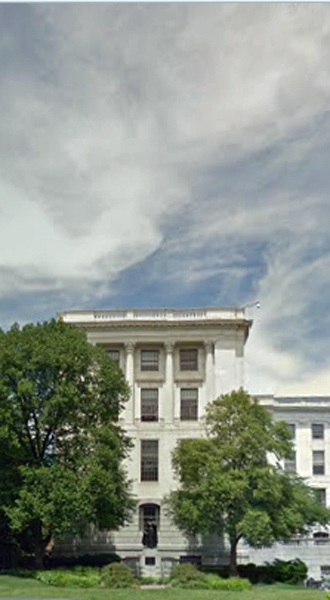
Obviously I didn't take this Google Maps photo, but I did doctor it up in Photoshop.

You just don't go to the Massachusetts
Statehouse and skip the
Mary Dyer statue! Besides, I'm
partial to Mary.

I was early to the Hutchinson statue event, and
who should I find also early? Frmr Massachusetts
Gov. Michael Dukakis (served three terms in the
1970s and 1980s). Why, yes, that is his hand on my
shoulder.

Who knew the Mass statehouse had a *Hooker* entrance?
It does! It's a real thing! Politicians and hookers--
what could go wrong?
General Hooker, from whom prostitutes got the appellation
of hooker, is memorialized with a bronze statue of
him on his horse. No sign of camp followers on this
steaming hot day, however.
The Hon. Michael Dukakis speaks to the crowd gathered
at the Anne Hutchinson statue. Yes, he and I had to use
the Hooker Entrance to get to this fenced area.
That's Anne Marbury Hutchinson Foundation president
Dr. Eric Nielsen behind Gov. Dukakis.

Hutchinson biographer Eve LaPlante speaks at the
Hutchinson birthday celebration
.

Anne Marbury Hutchinson and daughter (presumably
Susannah Hutchinson Cole) remembered in Boston, where
she was excommunicated and banished in 1638.

Dr. Eric Nielsen and Michael Steven Ford, both
Hutchinson descendants, with Valerie Debrule,
who was given an engraved crystal award to
thank her for her years of work on establishing
Founders Brook Park in Portsmouth, Rhode Island.
Boston Globe article on the Hutchinson birthday event: https://www.bostonglobe.com/metro/2016/07/20/descendants-one-massachusetts-first-feminists-mark-her-legacy/qY0vQFin304hQgv6PSVkxO/story.html 


*****

In addition to being author of the websites "William and Mary Dyer" and "Rooting For Ancestors,"  Christy K Robinson is the author of three highly rated books on William and Mary Dyer, which include Anne Hutchinson and son Edward, Gov. John Winthrop, Katherine Marbury Scott, John Cotton and John Wilson, and many more real people and events whose descendants are found all over the world, and a modern biography of Anne Marbury Hutchinson. Click the links to find both paperback and Kindle editions of the books.
·          We Shall Be Changed (2010)
·          Mary Dyer Illuminated (2013)
·          Mary Dyer: For Such a Time as This (2014)
·          The Dyers of London, Boston, & Newport (2014)
·          Effigy Hunter (2015)
·          Anne Marbury Hutchinson: American Founding Mother (2018)

Monday, June 13, 2016

Review of "The Savage Apostle"

King Philip's War, 1675-1676, was fought between the Native American tribes of New England, and the English colonists, many who were first-generation emigrants like William and Mary Dyer (William lived until 1677), or their children and grandchildren who were born in the colonies. The Dyers may have known Rev. John Eliot if he was one of the inquisitors on Anne Hutchinson's trial. William Dyer was acquainted with the Indian sachems Massasoit (whose signature mark was a sailboat or a bow) and his son Metacom/Metacomet. The Dyers' sons were involved with the war, and Samuel Dyer, their eldest son, rescued Rhode Island colonists from grave danger when he evacuated them to Newport. Katherine Marbury Scott lost both her sons in the war. Edward Hutchinson died a short time after being struck by a musket ball late in the conflict. We don't know much about the women who suffered death, injury, the firings of their homes and crops, and the loss of their children, but we can learn from the story of Mary Rowlandson, who was abducted by Native Americans and then redeemed. But fear not, our friend Jo Ann Butler is nearly finished with her volume encompassing this time, The Golden Shore.

I invite you to learn more about King Philip's War by reading The Savage Apostle, by John B. Kachuba. You can access the Amazon sales page and the other reviews by clicking the title hotlink.

The Savage Apostle, by John B. Kachuba
(Review by Christy K Robinson)

The Savage Apostle, named after John Eliot, the Congregational (Puritan) pastor to the Native Americans (“savages”) of New England, is the first historical novel by author John B. Kachuba. The “novel” genre assignment seems wrong, when the events and people were real and documented, but the narrative follows the thoughts and speech of two primary figures: Rev. John Eliot (1604-1690) and the Wampanoag sachem Metacom (1638-1676), also known as King Philip. Historical fiction can breathe new life into dusty history, when thought through as carefully as it was by author Kachuba.

The book begins with the musings of Eliot, who mourns the death of the Native American Sassamon, who was a Christian convert. Sassamon had been murdered and dumped in a frozen pond, perhaps by someone of his own tribe, or by the English settlers of Plymouth Colony. In 1675, tensions were high between the natives of New England, and the thousands of English families pushing them back into the wilderness. When the first settlers arrived in the 1620s and 1630s, they found whole villages made ghost towns by disease. They purchased land from native sachems, but by 1636, tensions broke out in the Pequot War, in which the Plymouth and Massachusetts Bay militias massacred thousands and sold women and children captives to the Caribbean slave trade (because they had a naughty habit of running away from their “servanthood” in New England). As tens of thousands of settlers arrived in the Great Migration, the various tribes suffered encroachment on their lands and waters, destruction of their crops by English cattle, and overhunting of fowl and deer. Over the next decades, even as John Eliot tried to convert them to Christianity and “civilization,” they lost civil rights and were treated disrespectfully by the second generation of colonists.

In the book, Metacom has equal time with John Eliot, as they both realize that war will come to New England, no matter how hard they work to avoid it. They both envision innocent deaths and burned-out villages. Eliot wonders if he has failed his God when he sees the “Praying Indians” deserting their villages ahead of the war to return to their tribes. He agonizes over the will of God: why did God seem to direct his missionary work, and then deny Eliot, in his old age, the fulfillment of happy, fulfilled Christian converts? Metacom wants only to die peacefully as an old man, with his children and grandchildren nearby, and go to the afterlife to be with his father and brother, but his advisors are bent on avenging the executions of the three Pokanoket men who were falsely accused and falsely convicted of murdering Sassamon.

Author Kachuba’s depiction of the exhumed body of Sassamon was (as I imagine) quite realistic, but so was his depiction of sudden emotion from Rev. Eliot, looking on the decomposing body of his friend and convert. “From where I now stood, trembling, I had an unobstructed view of the corpse, a view I would gladly have given up so as to have Sassamon’s memory from happier times live on within me… I had to close my eyes for several moments to calm my wild heart. My knees shook and I thought I should fall.”

I’ve read several books set in the time before and during King Philip’s War (among them Flight of the Sparrow, by Amy Belding Brown; Mayflower, by Nathaniel Philbrick; Caleb’s Crossing, by Geraldine Brooks), and have seen descriptions of Eliot and his ministry, and the English versus Indian conflict from several outside angles. It’s a new dimension to read about the precursors to war through the eyes of Eliot and Metacom, who perhaps had the best perspective.

As an author and a student of 17th-century New England history, I found the personal narratives fascinating. The story is so believable as told here, that I’m tempted to think this is what must have happened. As a genealogy enthusiast, I knew some of the peripheral players in the story, and though they weren’t covered in detail in the book (which was proper), it drove me back to my files to compare information. And it fits! Those dusty ancestors contributed to the story in my head. Dr. Fuller administered a potion which may have killed Metacom’s brother. Others lived heroically through the atrocities of King Philip’s War, ferried colonists from grave danger to safety at Newport, or, like one great-great, didn’t survive, when he was taken captive and marched to Canada, where he was burned at the stake.

There were a few confusing bits in The Savage Apostle: Metacom’s flashbacks to his experiences with father and brother took us back about 13 years but didn’t explain the timehop. What was the medieval law of cruentation? And the Pokanoket name of Montaup (Mount Hope, Bristol, Rhode Island) and other places could have been set for the reader who is not from New England, by a map or two. Sure, I can Google them, but that would mean getting out of bed where I’m reading in the wee hours!

The book contains a reading list and discussion guide, and would be appropriate reading for high school and college history students, as well as history enthusiasts of all ages. The few descriptions of violence (at the very end of the book) are necessary to a book about the prelude to war. The physical book is well made and the text is easy on the eyes. The cover image appears to be an aerial view of a landscape with water and clouds in the distance. The cover texture feels a bit like peachskin.

Disclosure: The publisher sent me an advance copy of the book in exchange for an honest review.

This article is copyrighted. Copying, even to your genealogy pages, is prohibited by US and international law. You may "share" it with the URL link because it preserves the author's copyright notice and the source of the article.  

Wednesday, June 8, 2016

Old Boston, the angels' view

© 2016 by Christy K Robinson

This article is copyrighted. Copying, even to your genealogy pages, is prohibited by US and international law. You may "share" it with the URL link because it preserves the author's copyright notice and the source of the article.  


What a photo from above Boston.
This was taken from Lincolnshire-based Kurnia Aerial Photography with a drone on June 6, 2016.

This large parish church, St Botolph's (aka "The Stump"), was the church where Rev. John Cotton was the minister for 20 years, and Anne and William Hutchinson attended here often. (Their children were baptized in the local church in Alford.) The young William Dyer and his parents and siblings lived in nearby Kirkby LaThorpe, so it's very possible that the Dyers occasionally or regularly attended this large church. 

St Botolph's (Anglican) church is located in Boston, Lincolnshire, near the northeast coast of England. Boston, Massachusetts, was named after this town for several reasons, including that it was a center for Theophilus Clinton (4th Earl of Lincoln) who was a religious nonconformist with interests in the New England colonies, and for the hope that John Cotton would accept their repeated invitations to emigrate to New England.

After The Book of Sports was republished by King Charles I, and the bishops and archbishop of the Church of England cracked down on Puritan power, Cotton was forced into hiding for a year lest he be imprisoned (which could be a death sentence in itself). He sailed to the new Boston in 1633, and about ten percent of old Boston followed him.

William Dyer and his father, a farmer who owned his land about 15 miles to the west (behind the drone camera), were certainly familiar with the market square at the east end of the church. Whether they brought crops or wool or livestock to market, Boston was a second "hometown" to them.


Christy K Robinson is author of these books (click the colored title):
Mary Dyer Illuminated Vol. 1 (2013)  
Effigy Hunter (2015)  

And of these sites:  
Discovering Love  (inspiration and service)
Rooting for Ancestors  (history and genealogy)
William and Mary Barrett Dyer (17th century culture and history of England and New England)

Friday, May 27, 2016

Where were Anne Hutchinson's trials held?

File deleted by author, but used as a chapter in the book, 


Wednesday, May 18, 2016

Anne Hutchinson: Brief life of Harvard's "midwife" from Harvard Magazine


Your independent source for Harvard news since 1898

Anne Hutchinson

Brief life of Harvard's "midwife": 1595-1643


On June 2, 1922, the Commonwealth of Massachusetts received from the Anne Hutchinson Memorial Association and the State Federation of Women's Clubs a bronze statue of Anne Hutchinson. The inscription read in part:
In Memory of Anne Marbury Hutchinson
Courageous Exponent of Civil Liberty
and Religious Toleration
It might have added that Mrs. Hutchinson was the mother of New England's first and most serious theological schism (traditionally known as the Antinomian Controversy); that in debate she bested the best of the Massachusetts Bay Colony's male preachers, theologians, and magistrates; and that as a result of her heresy the colony determined to provide for the education of a new generation of ministers and theologians who would secure New England's civil and theological peace against future seditious Mrs. Hutchinsons "when our present ministers shall lie in the dust," as the inscription on the Johnston Gate puts it. Thus, Anne Hutchinson was midwife to what would become Harvard College...

Read the rest of the story at Harvard Magazine, http://harvardmagazine.com/2002/11/anne-hutchinson.html


________________________________

Christy K Robinson, the author of this Dyer research blog and three books on William and Mary Barrett Dyer, has been invited to participate in a conference on Anne Hutchinson, held in Massachusetts, Rhode Island, and New York in July 2016. Christy will take her place on a panel discussion, and speak about Anne Hutchinson and Mary Dyer at Harvard University. (Which, as you may know, is a very big deal!) If you can help with the expense of travel, accommodations, and research into both Dyer and Hutchinson records, please use the Paypal donation button in the sidebar of this website.

Saturday, May 14, 2016

Mary Dyer changed the world. This is how.

© 2016 Christy K Robinson

Mary Barrett Dyer didn't stop to ask if the people of New England who were being beaten and whipped (with scarring for life), imprisoned in Boston and New Haven prisons without heat during polar blizzards, fined into poverty, having their property confiscated and given to the religious magistrates to dispense, or were hanged, were "worthy" of her sacrifice.


Mary Dyer purposely left a place of safety on Shelter Island, literally crossed the ocean to get to Providence, and walked more than 40 miles through dangerous wilderness, to give up her life if the theocratic government would not rescind their "bloody law" against non-conformists. She didn't sneak into Boston: she boldly appeared there when there were hundreds or thousands more people in town for the annual elections and superior courts.

She wasn't an obscure, no-name bumpkin: she was a co-founder of Portsmouth and Newport. She was the wife of the first attorney general in America, an admiralty court judge, the commander-in-chief of the Anglo-Dutch war in New England waters, and solicitor general of Rhode Island. She was better educated than many men of her generation. She'd been reprieved from the gallows seven months before, in a scripted drama cooked up by the governor, his staff, and several ministers, because they knew killing her would  antagonize the many people who respected and sided with Mary.

Mary defied that theocratic government to call attention to their brutality and injustice, and was prepared to die to stop their practices and spare people of conscience. People like Quakers and Baptists, and those who didn't share the same beliefs as the oppressors. And she went through with it, even when she was offered her life if she'd just leave Massachusetts.

That's what love does. That's what a mother would do for her children, and other peoples' children, young or old. And whether or not we carry Mary Barrett Dyer's DNA, we are all her children because of her civil disobedience unto death. That was love. Be like Mary. Love one another, whether they're worthy or not. It will change your life. And it will change the world.


Christy K Robinson is author of these books:
Mary Dyer Illuminated Vol. 1 (2013)  
Effigy Hunter (2015)  

And of these sites:  
Discovering Love  (inspiration and service)
Rooting for Ancestors  (history and genealogy)
William and Mary Barrett Dyer (17th century culture and history of England and New England)
Editornado [ed•i•tohr•NAY•doh] (Words. Communications. Book reviews. Cartoons.)


 If you enjoy this Dyer website (200 articles so far) or the books, please consider helping with the research expense at the Paypal button on the sidebar of this website. Thank you very much!