Wednesday, June 19, 2013

Zerubbabel Endecott, 17th-century physician and pharmacist

Remedies guaranteed to cure hypochondria and malingering! 
Short life sketch of Zerubbabel Endecott

© 2013 Christy K Robinson


Print by Jan van der Bruggen, 1665-1690.
Interior of a surgery with a surgeon seated
on a barrel and operating on a peasant man,
an old woman standing with her arm in a sling,
several shelves on walls in background,
a stuffed animal hanging from ceiling. Mezzotint.
 Be very glad for modern scientific research, sterility, and effective and measured anesthesia, none of which were known in 17th-century Europe or North America. You wouldn't want your childbirth pain treated with cat's blood and human milk, curing your nosebleed with hog's dung, or your seizures treated with Salt of Man's Skull (exactly as it sounds).

Gov. John Endecott was the man I call the “Hammer of the Quakers.” He sentenced Quaker missionaries to severe whippings, starvation and exposure, imprisonment, and death. He sentenced Mary Dyer to death by hanging for her civil disobedience, and countenanced the brutal torture and incarceration of Quakers throughout the Massachusetts Bay Colony. Baptists were also treated in an extremely harsh manner from at least 1650 on.

Gov. John Endecott had fathered an illegitimate son in England in the 1610s or 1620s, but wrote at least one letter saying that although he was providing some money for his upkeep, the boy was not to be sent to New England under any circumstances. John been married in England in the mid-1620s to an Anna Gover, but they had no children, and she died soon after her arrival in Massachusetts Bay. In August 1630, he married the widow Mrs. Elizabeth Gibson. She bore him two sons, John Jr., and Zerubbabel. Zerubbabel was born about 1635 in Salem.
The Maypole of Merry Mount: Thomas Morton & the Puritan Patriarchs, By Richard Drinnon
https://www.jstor.org/journal/massreview  The Massachusetts Review Vol. 21, No. 2
(Summer, 1980), pp. 382-410 (29 pages)

When he was about 18 years of age, Zerubbabel was accused of raping his mother’s indentured lace-maker, Elizabeth Due/Dew. Testimony of other female servants told of Zerubbabel's serial sexual harassment and that they didn't want to be left alone with him. The servant girl Elizabeth, who gave birth in 1653-54, continued to accuse Zerubbabel even after her trial for slander, two serious public whippings totaling about 30 lashes, being released from her indenture early as a hush-reward, being hurriedly married off to another servant, Cornelius Hulett, who endured a whipping he didn't deserve, and told to leave.

As part of my research, I found some Hulett/Hewlett young adults in Rhode Island about 20-30 years later, but could not connect them with Elizabeth and Cornelius, so there's no proof they were related. Elizabeth and Cornelius disappeared from records, and I wonder if they changed their surname, died of a disease, lived off the grid (to use an anachronism), or moved back to England. 

Gov. John Endecott was not having his first grandchild born illegitimately, and of rape, to a mere servant girl, and he was not chaining his son to her for life, as the courts usually did after publicly whipping both fornicating parties.
Gov. John Endecott in the 1650s.
He may be wearing the lace made
by his wife's abused servant.

After his shameful conduct for which he was never tried, Zerub—as I shall abbreviate his name—was immediately wedded, about eight years earlier than most young men would marry, to a woman named Mary Smith, and then he was not heard of for a few years. Zerub probably sailed away to England for medical education as a chirugeon (surgeon). The custom was to read medicine in the home of a physician and go with him on patient rounds. In any case, he was back in Massachusetts by 1659, for he and his brother John were fined for drunkenness, another blow to the pride of his father, the governor. 

Zerub and Mary had ten children during their 23 years of marriage. He was made a freeman in 1665 (the  year his father died). He was a winning defendant in a trespass suit by a Mr. Nurse (of the Mrs. Rebecca Nurse witchcraft name) in June 1683, Zerub having logged valuable timber for firewood off the land in question; several Salemites testified that he had logged within his own boundaries. Five months later, he made his will, which indicates a life-threatening injury or illness, and two months after that he died.

Zerub’s will, made before his death at age 49 in the winter of 1684, specified cash bequests of £50 each to his daughters Mary, Sarah, Elisabeth, Hanna, and Mehetabel; farm properties to his sons; to his son John, also a physician, he left “all my Instruments and books of phisicke and chirurgery.” The inventory of medical instruments showed “a case of lances, 2 Rasors, a box of Instruments, a saw with six Instruments for a Chirurgion, a curb bit.” 

During Zerub’s medical practice, he took notes and in 1677 wrote a short book, entitled Synopsis Medicinae or a Compendium of Galenical and Chymical Physick Showing  the Art of Healing according to the Precepts of Galen & Paracelsus Fitted universally to the whole Art of Healing. It contains directions for mixing and applying medicines for the cure of disease or healing from surgery. The manuscript bears the byline “Zorubbabel Endecott.” You can find the booklet in several formats, HERE. 

The following recipes are a few of the concoctions Dr. Zerubbabel Endecott preferred for his treatment of Salem patients between 1659 and 1684. Interesting ingredients, considering the witchcraft craze less than 10 years later.

For ye Colic or Flux in ye Belly
the powder of Wolves guts
the powder of Boars Stones [testicles?]
oil of Wormwood a drop or 2 into the Navel
3 drops of oil of Fennel & 2 drops of oil of mints in Conserve of Roses or Conserve of single mallows, if ye Pain be extreme Use it again, & if need Require apply something hot to the belly

For Vomiting & Looseness in Men Women & Children
Take an Egg break a Little hole in one end of it & put out ye white then put in about 1/2 spoonful of bay salt then fill up the egg with strong Rum or spirits of wine & set it in hot ashes & Let it boil till ye egg be dry then take it & eat it fasting & fast an hour after it or drink a Little distilled wafers of mint & fennel which waters mixed together & drank will help most ordinary Cases

For a Person that is Distracted If it be a Woman
No cat's blood! 
"Take a he-Cat & Cut off one of his Ears
or a piece of it & Let it bleed..."
 Take milk of a Nurse that gives suck to a male Child & also take a he-Cat & Cut off one of his Ears or a piece of it & Let it bleed into the milk & then Let the sick woman Drink it, do this three Times

For the Shingles
Take house leek, Cats blood, and Cream mixed together & oint the place warm or take the moss that groweth in a well & Cats blood mixed & so apply it warm to the place where shingles be.

For a Cancer in a Womans Breast
A woman at Casko bay had a Cancer in her breast which after much means used in Vain they applied strong beer to it with Double Cloths which it drank in Very Greedily & was something eased afterwards beer failing they Used Rum in Like manner which seem to Lull it asleep afterwards they put Arsenic into it and dressing it twice a day it was Perfectly whole in the mean time her Kind husband by Sucking drew her breast with ye Loss of his Fore teeth without any farther hurt. Re New Englands Experiences

For Sharp & Difficult Travail in Women with Child
Take a Lock of Virgins hair on any Part of ye head, of half the Age of ye woman in travail. Cut it very small to fine Powder then take 12 Ants Eggs dried in an oven after ye bread is drawn or otherwise make them dry & make them to powder with the hair, give this with a quarter of a pint of Red Cows milk or for want of it give it in strong ale wort.

For ye Tooth Ache
Take a Little Piece of opium as big as a great pins head & put it into the hollow place of the Aching Tooth & it will give present Ease, often tried by me upon many People & never failed. Zerobabel Endecott. 

Falling Sickness (epilepsy or seizure)
In Children. has of the dung of a black Cow 3i. given to a newborn Infant, doth not only preserve from the Epilepsia, but also cure it. In those of ripe Age. The livers of 40 water-Frogs brought into a powder, and given at five times (in Spirit of Rosemary or Lavender) morning and evening, will cure, the sick not eating nor drinking two hours before nor after it. Compendium of Physick (Salmon), London, 1671.
Salt of Mans Skull. The skull of a dead man, calcine it, and extract the Salts as that of Tartar. It is a real cure for the Falling-sickness. Vertigo, Lethargy, Numbness, and all capital diseases, in which it is a wonderful prevalent.Compendium of Physick (Salmon), London, 1671.

To stop bleeding of the nose
If the flux be violent, open a vein on the same side, and cause the sick to smell to a dried Toad, or Spiders tied up in a rag; the fumes of Horns and Hair is very good, and the powder of Toads to be blowed up the Nose; in extremity, put teats made of Swines-dung up the nostrils. Compendium of Physick (Salmon), London, 1671.
Hog’s Dung is also used by the Country People to stop Bleeding at the Nose; by being externally applied cold to the Nostrils. English Dispensatory (Quincy), London, 1742.

Thursday, June 13, 2013

Why the Pilgrim governor wanted to know about the Dyer “monster”

© 2013 Christy K Robinson

In October 1637, Mary Dyer gave birth to a premature, stillborn girl, which, according to descriptions, was anencephalic (lacking more than a brainstem) and probably had spina bifida (neural tube defects). (See link to my article at the end.) This was the first anencephalic baby ever reported in America. 

Drawing depicts an anencephalic child born in England,
but not Mary Dyer's child.
It had no head, nor any sign or proportion thereof,
there only appeared as it were two faces,
the one visibly to be seen, directly placed in the breast,
where it had a nose, and a mouth, and two holes
for two eyes, but no eyes, all which seemed ugly,
and most horrible to be seen, and much offensive
to human nature to be looked upon,
the other face was not perfectly to be seen,
but retained a proportion of flesh in a great round lump,
like unto a face quite disfigured, and this was
all of that which could be discerned. 
The face, mouth, eyes, nose, and breast,
being thus framed together like a deformed piece of flesh,
resembled no proportion of nature, but seemed
as it were a chaos of confusion,
a mixture of things without any description...

Back in their native country, England, gravely-deformed babies were called “monsters” or “monstrous births,” and were commonly known to be heaven-sent proof of heresy or monstrous religious or political beliefs of the mother. 

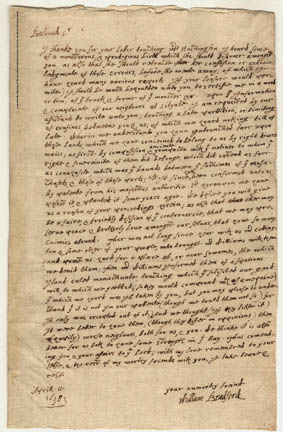
A holograph of William Bradford's letter to
John Winthrop regarding Mary Dyer's stillborn baby.
Source: Massachusetts Historical Society
 On April 11, 1638, in the first month after the revelation of Anne’s trial and Mary’s monster, the governor of Plymouth Colony, William Bradford, wrote a letter to his friend and colleague, John Winthrop. Most of the letter was about colonial boundaries and the islands in the Narragansett Bay, which Plymouth insisted were part of their original royal patent.

The first part of the Bradford letter asked for juicy details of Mary Dyer’s poor baby. 

"Beloved Sir: 
I thank you for your letter touching Mrs Huchngson [Anne Marbury Hutchinson]; I heard since of a monstrous, & prodigious birth [Mary Dyer's miscarriage which Anne attended] which she should discover amongst you; as also that she should retract her confession of acknowledgment of those errors, before she went away..."

THE REST OF THIS ARTICLE HAS BEEN REMOVED BY THE AUTHOR AND IS INCLUDED IN THE BIOGRAPHY, Anne Marbury Hutchinson: American Founding Mother (2018).  
For more information on Mary Dyer’s “monster,” visit my blog article HERE.

Saturday, June 1, 2013

Mary Dyer and Martin Luther King Jr on civil disobedience

© 2013 Christy K Robinson
“Civil disobedience is always a criticism of the existing power structure. And it's always been that way. That's the role of civil disobedience. That's the role of dissent.” ~Tim DeChristopher, environmental activist who disrupted an auction, was convicted, and then chose to serve two years in prison instead of taking a plea bargain.

The Calvinist Puritans of colonial America believed that one could never know if God would award salvation and eternal life. They obeyed the Old Testament biblical and civil laws scrupulously, and performed good works in the hope that God would find them worthy; and they took comfort from their difficult task. They believed that God had a body of people who he’d predestined for eternal life. They called themselves the Elect, or the Remnant, after the proportionately-small group of faithful believers mentioned in the Book of Revelation.

Mary Dyer, who had rejected that dogma with her adherence to the teachings on grace of Anne Marbury Hutchinson, became a Quaker in the 1650s. That sect believed that with the New Covenant that came with Christ on the cross, God would replace the laws written on stone (the Ten Commandments) with a God-given conscience that told one what was right and wrong. They believed that eternal life was a gift to any person who trusted God (that he loved his children and desired their salvation) and obeyed the conscience. Mary went to her death on the gallows with perfect confidence that her next breath would be drawn in heaven.

For the persecuting Puritans of colonial Boston and Plymouth, the Quaker loosie-goosie feel-good religion that went straight from believer to God and back, instead of through the deliberative filter of church and state, was a clear threat to their authority and would result in chaos and anarchy. They’d also lose their royal charter, life savings, tithes and taxes, political power, and personal investments in the colony if a royal governor were sent. They wanted those Quakers rooted out and kept out.

William Robinson, Marmaduke Stephenson, Mary Dyer, and many other early Quaker converts were given a choice to leave the colony and live, or stay and be brutally beaten and probably executed. Most of us today would think there’s no contest about what to do. But the Quakers believed that God had specifically commanded and placed them there, and they were happy about it! Rather than avoid trouble, they took a lot of effort to stir up the people to anger against their government—anger that would change laws and bring justice, mercy, righteousness, and liberty to their colony.

What Robinson, Stephenson, and Dyer saw in their minds’ eyes was that long-range goal, and they were not only willing, but joyful, at their selection and assignment to do God’s will. 

Mary Dyer's handwriting from October 1659:
"...but to me to live is Christ and to die is gaine..."
The phrase is taken from the New Testament letter of Paul to the believers in Philippi, Macedonia.

"It is my own eager expectation and hope, that [looking toward the future] I will not disgrace myself nor be ashamed in anything, but that with courage and the utmost freedom of speech, even now as always, Christ will be magnified and exalted in my body, whether by life or by death. For to me, to live is Christ [He is my source of joy, my reason to live] and to die is gain [for I will be with Him in eternity]." 

October 1659 execution date (from which Mary was reprieved)
Mary’s letter to the General Court: ‘Therefore I leave these lines with you, appealing to the faithful and true witness of God, which is one in all consciences, before whom we must all appear; with whom I shall eternally rest, in everlasting joy and peace, whether you will hear or refuse. With him is my reward, with whom to live is my joy, and to die is my gain.”

Governor John Endecott of Massachusetts Bay Colony said, 'Take her away, marshal.' To which she returned, 'Yes, joyfully I go.' And in her going to the prison, she often uttered speeches of praise to the Lord; being full of joy.

The marshal asked Mary, "Are you not ashamed to walk thus between two young men?" "No,” answered Mary Dyer, "this is to me an hour of the greatest joy I ever had in this world. No ear can hear, no tongue can utter, and no heart can understand, the sweet incomes and the refreshments of the Spirit of the Lord, which I now feel."

June 1, 1660 march from prison to gallows:  
When offered her life if she would voluntarily leave the colony forever, Mary Dyer said no, “For in obedience to the will of the Lord I came, and in His will I abide, faithful unto death."
Someone from the crowd called out, "Did you say you have been in Paradise?"
Mary answered, "Yea, I have been in Paradise several days and now I am about to enter eternal happiness."

Dr. Martin Luther King, Jr., martyr for civil rights, in a speech just before his assassination.
 “Well, I don't know what will happen now. We've got some difficult days ahead. But it really doesn't matter with me now, because I've been to the mountaintop. And I don't mind. Like anybody, I would like to live a long life. Longevity has its place. But I'm not concerned about that now. I just want to do God's will. And He's allowed me to go up to the mountain. And I've looked over. And I've seen the Promised Land. I may not get there with you. But I want you to know tonight, that we, as a people, will get to the promised land!” 

*****  
CIVIL DISOBEDIENCE

  • Obedience to a higher authority
  • Refusal to obey unjust or immoral laws
  • Publicizes unjust, immoral actions perpetrated by those in authority
  • Rarely passive or peaceful, but must be non-violent
  • Has consequences
  • Change is rarely instantaneous
For the Quaker martyrs and for Martin Luther King, Jr., civil disobedience was not a matter of merely protesting the existence of the government, or making a public statement of rebellion against government authority. It was a matter of obeying the higher authority, God, and the conscience (God's "voice" in your soul), while addressing the injustices of human beings viciously persecuted for their religious beliefs, or their right to exist as equal under God.

*****
For information on the June 1, 1660 death of Mary Barrett Dyer, Englishwoman and colonial American, read the following links already posted in this blog.
Top 10 things you may not know about Mary Dyer
Mary Dyer: The establishment versus the individual
Mary Dyer and freedom of conscience
Mary Dyer and the First Amendment
Mary Dyer, pioneer of civil disobedience 

Read The Dyers series by Christy K Robinson, available at
http://bit.ly/RobinsonAuthor

Tuesday, May 21, 2013

Mary Dyer's last 44 miles

© 2013 Christy K Robinson

The estimated walk time from Providence to Boston would take 14 hours, but these days, the road is paved and level; in Mary Dyer's time it would have been uphill and downhill, over streams or low, wet places, with gullies eroded after strong storms. The English colonists and farmers were not on the best of terms with Native Americans. There were bounties on wolves. Cougars and bears lived in the forest. Mary had walked it before in company of protective men, but on the last two occasions, she had only the company of sisters Mary Scott (age 17) in 1659 and Patience Scott (age 12) in 1660.

The road between Boston and Providence, Rhode Island, was a familiar one to William and Mary Dyer. When it was hardly more than an Indian path through the forests and streams of Massachusetts, William had been part of the scouting parties which purchased Rhode Island from the Narragansett Indians.

Then in the snowy spring of 1638, he and Mary elected to walk the path with the Hutchinson party after their expulsion from Massachusetts. They probably shipped their possessions around Cape Cod, but walked away like the Bible’s children of Israel, as a symbolic exodus from the heavy, theocratic hand of the Massachusetts Bay authorities.

The road would have been enlarged by commercial traffic and military expeditions during the late 1630s and early 1640s. William Dyer, as a Rhode Island government official and an attorney, would have traveled the road back to Boston many times. We don’t know if Mary accompanied him, because the next record we have of Mary is that she arrived by ship at Boston in March 1657 and was imprisoned as a Quaker. 

William took Mary back to Newport, via the road to Providence, in summer 1657. But between 1658 and 1659, she’d made the trip from Providence to Boston several times with other Quakers, each time to support the imprisoned or call for their release. She was herself arrested several times, and was sentenced to be hanged on October 27, 1659. However, she was reprieved and was supposed to go home to Newport, Rhode Island.

She did, but not for long. (Her husband William said the next spring that the last time he saw his wife was in November.) About two weeks later, she’s mentioned as being in Plymouth Colony’s town of Sandwich, visiting the Quakers there. She was jailed and released.

She must have traveled from Sandwich to the Sylvester home on Shelter Island (eastern reaches of Long Island). There, she spent the winter in the company of her Friends, some of whom had been severely persecuted in Boston. In May 1660, Mary sailed across Long Island Sound, eastward to Narragansett Bay. Not stopping at her home in Newport, where resided her husband and children, she continued up the estuary and Seekonk River to Providence. Richard and Katherine (Marbury) Scott were co-founders of Providence, and were undoubtedly friends of many years—since at least 1635 when the Scotts, Hutchinsons, and Dyers lived in Boston. Katherine was Anne Marbury Hutchinson’s youngest sister, and was about a year older than Mary. Richard became a Quaker on a 1654 trip to England, which would make him the first Quaker in New England, if not America. His conversion predated the arrival of Quaker missionaries in 1656 and 1657. So the Scott home in Providence would have been the hub for Mary’s and other Quakers’ forays into Massachusetts.

This modern plotting of the route from Providence, RI, to Boston, MA, follows US 1 or 1A most of the way.
It's likely that this was also the original Indian path and later a wagon road.

Mary could have used her husband’s horses or rented a ride for herself and Patience Scott. But I believe this walk was symbolic of her first forced march out of Boston, with the Hutchinsons. She walked out then, and now she was walking back to prove they’d not been able to beat her down. This was on her terms.

Mary Dyer and Patience Scott (12-year-old daughter of the Scotts, and niece of Anne Hutchinson) arrived in Boston on May 21, 1660, having walked from Providence, Rhode Island. Patience had walked this road several times, too, and had been jailed in Boston the summer before for preaching Quaker beliefs.

Mary and Patience arrived during the annual proceedings of the Massachusetts Bay Court, when the Governor, deputy governors, and other officials would be in Boston for annual elections, to hear superior court cases, and vote legislation based on their blend of religious and civil law. John Endecott had been reelected governor on May 20, and at his home in Salem that night, there had been a terrific thunderstorm for six hours, from 9pm to 3am. The lightning was so severe and long-lasting that it was recorded in the Salem annals. Mary and Patience were probably spending the night in the forest or countryside outside Boston's peninsula, and might have been subjected to similar weather.

On the morning of May 21, Mary Dyer and her Quaker Friends from Salem and Plymouth gathered in Boston to protest the extreme persecution of Quakers, knowing full well that they would be jailed, probably beaten, and in Mary's case, executed (June 1, 1660). To enter Boston, Mary would have walked past the gallows at the fortification on Boston Neck.
US 1, the road between Boston and Providence, in the Wrentham area.

As suggested by the Google map, a direct hiking route from Providence to Boston would be about 44 miles. I don’t know if this is the route Mary’s road would have taken—over the course of decades and centuries, roads don’t really move or change, they just enlarge or maybe straighten a bit. I imagine that the U.S. 1 and Interstate-95 corridors had their origins on the old Indian footpath, the most direct and easy route, that became a wagon road, then was paved, and at last became a turnpike. The path plotted on Google runs that corridor. When I drove that route, I noticed how hilly the terrain was, and the numerous "road cuts" where the hills were cut down and leveled for the freeway. Mary's path may have meandered a bit more, following contours of the land.

Mary thought, on her last two journeys, that she was going to her death. She must have had faith that she was protected by God while on his errands through a wilderness that was both spiritual and physical.

And remembering the Ginger Rogers quip about dancing backwards and in heels, Mary did it in long skirts, carrying a pack of supplies for sleeping and eating on the journey. Surely there was plenty of time over the two to four days they were walking, for communion with God and each other. Mary’s next walk would be from the prison to the gallows on Boston Neck.

If it were you, would you make the long, hard walk of 44 miles, or would you take an alternate mode suggested by Google? They suggest public transit. Now, where's the public demonstration or the civil disobedience in that??

*****

http://bit.ly/RobinsonAuthor
Christy K Robinson is author of two biographical novels on William and Mary Dyer, and a collection of her nonfiction research on the Dyers. In 1660, Mary Dyer was hanged for her civil disobedience over religious freedom, and her husband’s and friends’ efforts in that human right became a model for the United States Constitution’s Bill of Rights 130 years later. The books (and Kindle versions) are available on Amazon. CLICK http://bit.ly/RobinsonAuthor for the lbooks.
And if you'd like to own or give an art-quality print of Mary Dyer's handwriting, her letter to the General Court of Massachusetts, CLICK HERE

Wednesday, May 1, 2013

Wall Street’s beginning: Plenty of bull

© 2013 by Christy K Robinson

Source: Bloomberg
 Three hundred sixty-some years ago, there were definitely bulls on Manhattan Island, but there was no Wall Street. The colonists of the Dutch West Indies Company inhabited the southern tip of the island, a city they called New Amsterdam. It was the Dutch capitol in America, from which they administered parts of Long Island, Delaware (after they snatched it from Swedish colonists), New Jersey, and their opportunistic settlements in Connecticut and the Hudson River Valley. Their director-general was Pieter Stuyvesant, who had administered the colony since 1647.

After Stuyvesant traded away large portions of territory to the English colonies of New Haven and Connecticut, his Dutch colonists were quite upset with him. The tensions with the Native Americans were always ready to flare up, and several unscrupulous Dutchmen had been discovered selling rum, firearms, and ammunition to the Indians — firearms and ammo that could be used to massacre colonists.

In 1652, a naval war between England and the Netherlands had broken out not only in the English Channel, but in the Caribbean and the trade routes and ports of the Atlantic. Piracy and privateering were rampant. The English settlers on Long Island and the coasts along Long Island Sound learned that the Dutch were paying the Indians to attack the English and drive them off.

When settlers like the militia commander Captain John Underhill, a magistrate in the New Haven-governed area of Long Island, called for his fellow Englishmen to rise up against “the iniquitous government of Pieter Stuyvesant,” he was first imprisoned for sedition, then kicked out of New Netherland. (Captain Underhill had a Dutch wife and mother-in-law, so living among the Dutch was not a foreign concept to him.)

In the winter of 1652-53, both the English and Dutch settlers on Long Island were dissatisfied with Stuyvesant’s governing. They held community meetings and sent deputies from each village to demand reforms of the director-general, which he dismissed with the arrogant statement, “We derive our authority from God and the Company, not from a few ignorant subjects.”  

Captain William Dyer (husband of the woman who would become the famous Quaker martyr in 1660, Mary Dyer), was at this time Rhode Island attorney general, and had already been commissioned by England’s Council of State in early October 1652. His orders were to “raise such forts and otherwise arm and strengthen your Colony, for defending yourselves against the Dutch, or other enemies of this Commonwealth, or for offending them, as you shall think necessary; and also to take and seize all such Dutch ships and vessels at sea, or as shall come into any of your harbors, or within your power, taking care that such account be given to the State as is usual in the like cases.” 
 
New Amsterdam city plan in 1660. The wide street is now known as
Broadway, and the Wall is shown with guard posts. It's interesting that
like the original Amsterdam, there are canals for goods transport.

On March 17, 1652, six wealthy men of New Amsterdam, meanwhile, fearing both Indian and English attacks on their city, raised six thousand guilders to build a defensive palisade. They contracted with Thomas Baxter, a young English colonist living there, to, within two weeks, provide masses of cut lumber and logs to build the wooden wall. (Baxter would shortly thereafter criticize Stuyvesant and leave his small home and catboat, to join the privateer forces under William Dyer and John Underhill.)

Stuyvesant ordered all men of the town, under pain of fine, loss of citizenship, and banishment, to dig a defensive ditch and post holes for the palisade that would run right across the island there, and make two gates and gatehouses, at what would later be called Broadway, and at the water gate on the East River. The wall was 2870 feet long (a little over half a mile), from the western end on the bluff of the Hudson River, to the East River. The palisade was built during the month of April, and completed on May 1, 1653. The earthen wagon road inside the palisade was called Waal Straat.

It's interesting that though there were substantial Dutch residential and commercial settlements on nearby Long Island (Bronx, Brooklyn), no wall was attempted there.

In May 1653, Dyer and Underhill were commissioned by Rhode Island and the United Colonies of New England as Commander-in-Chief Upon the Seas (Dyer) and Commander-in-Chief Upon the Land (Underhill).

William Dyer and John Underhill never attacked New Amsterdam, probably because of lack of financial and material support from the English Council of State, and the First Anglo-Dutch War ended by treaty in January 1654. Dyer's privateers Baxter and Hull seized several ships and properties not only of Dutch traders, but of Englishmen who lived in Dutch territories, and there were several admiralty court cases required to resolve finances and ownership of ships and goods.

New Amsterdam was renamed "New York" in 1664 at the conclusion of the Third Anglo-Dutch War, when by treaty, England abandoned the Spice Islands of Indonesia (and parts of the Caribbean), and the Netherlands surrendered their colony and trading territories around Long Island Sound, Manhattan, and the Hudson River, allowing the English to administer those lands.

From 1680-82, Mary and William Dyer’s second son, William Dyre the younger (born about 1640 in Newport, Rhode Island), was mayor of the city of New York.

The Wall, having decayed over the last forty years, was dismantled in the 1690s, and the street that ran along the palisade became one of the most famous streets in the world — the home of high finance, and synonymous with greed and corruption.

To share this story, copy and paste this link into social media: https://bit.ly/2RJwH7H 

********** 
Mary Dyer, having been made famous by Quaker historians, has received all of the attention over the last 400 years, but her husband William Dyer was a remarkable man in his own right. Read about both of them in the biographical narratives by Christy K Robinson.  Click HERE to learn more about the Dyers.

**********  

Christy K Robinson is author of these sites:
and of these books:
·          We Shall Be Changed (2010)
·          Mary Dyer Illuminated (2013)
·          Mary Dyer: For Such a Time as This (2014)
·          The Dyers of London, Boston, & Newport (2014)
·          Effigy Hunter (2015)
·          Anne Marbury Hutchinson: American Founding Mother (2018)

Monday, April 8, 2013

Does America have Founding Mothers?


© 2013 by Eve LaPlante Used by permission

Three hundred and seventy-five years ago this month, Anne Hutchinson, forty-six years old and pregnant for the sixteenth time, became the only woman ever to co-found an American colony. She had recently been banished from Massachusetts for presuming to teach men – in addition to women, which was permissible – about the Bible. Then, in March 1638, after spending the winter under house arrest, apart from her family, Hutchinson was excommunicated by the First Church in Boston. Meanwhile, her husband and elder sons and a few male supporters sailed south to settle Portsmouth, Rhode Island, near Providence Plantation, which had been settled two years earlier by the Reverend Roger Williams, another Massachusetts outcast. In early April, accompanied by a large group of family and friends, Anne Hutchinson set out in thigh-deep snow to walk to her new home of Rhode Island, which would later merge with Williams’s settlement to form the colony of Rhode Island and Providence Plantation.
Anne Hutchinson memorial statue in Boston,
near Mary Dyer's statue.
Who was this remarkable woman? A child of Elizabethan England and of Shakespearean London, Anne Hutchinson had been born in Lincolnshire, England, in 1591, and spent her adolescence in a vicarage across the Thames from the Globe Theatre. Her father, a brilliant preacher who had himself been tried and imprisoned by the Church of England, gave her a defiant self-confidence and the gift of explaining Scripture. From her mother, an aunt of the poet John Dryden, she learned midwifery. At the age of twenty-one she married a wealthy merchant named William Hutchinson and returned to Lincolnshire, where she raised their large family and taught Puritan theology to other women at her home.
For the next twenty years, Hutchinson collaborated with the celebrated Puritan minister John Cotton, who credited her with “preparing souls” for him to convert. “She had more resort to her for counsel about matters of conscience and clearing up men’s spiritual estates,” he said, “than any minister.” But Cotton sailed to Boston, Massachusetts, in 1633, after being silenced by the Church of England. Hutchinson and her family followed a year later, and by 1636 she was lecturing weekly to audiences of as many as eighty women and men in her Boston parlor.
Rev. John Cotton
In her lectures she accused some colonial ministers of neglecting the central role of God’s grace in salvation. She charged them with preaching a “covenant of works” rather than the acceptable, Puritan “covenant of grace” elucidated by John Calvin. In Puritan theology, there was no causal link between doing good works and being saved. One could not achieve salvation through his or her own efforts or good works. To be eligible for salvation one had to be elected, before, by God. In early New England, however, ministers allied with Governor Winthrop preached that people could prove themselves worthy of salvation by displaying faith and performing good works – an appealing theological conceit that enforced obedience. This troubled Hutchinson, who was grounded in Calvinist theology and possessed of a strong sense of communion with the Holy Spirit. Moreover, her covenant of grace, with its immediate, felt sense of God’s pres­ence, offered religious assurance to many people whose experiences at the meetinghouse left them anxious. “Seek for better establishment in Christ,” she advised her listeners, “not comfort” in “duties,” “works,” or “performances or righteousness of the law.”
Gov. John Winthrop
Stung by her challenge, Governor Winthrop called her before the Massachusetts General Court on a charge of heresy for teaching, which he considered “not comely for [her] sex.” He derided her as “this American Jezebel,” a name any Puritan would recognize as belonging to the most evil woman in the Bible. At her civil trial, in 1637, and her church trial, in 1638, she defended herself brilliantly. Brazenly she informed the judges of the Massachusetts General Court, “I will give you the ground of what I know to be true.” In an era when a woman could not vote, hold public office, sign a legal document, teach men, or teach anyone outside her own home, Anne Hutchinson believed in the power of the individual con­science to determine the truth.
Three hundred and seventy-five years later, in a nation that lacks for founding mothers, Anne Hutchinson deserves consideration. She co-founded a colony. She was midwife to the nation’s first college: a week after banishing her, the Massa­chusetts court ordered the building of Harvard College to enforce religious orthodoxy and to prevent a charismatic radical like her from ever again holding sway. She is one of the early Americans whose commitment to independent judgment inspired the religious-freedom clauses in the 1663 charter of Rhode Island and Providence Plantation and, ultimately, the 1789 Constitution of the United States. Her belief in the ability of the individual con­science to look inward to determine what is true underlies our modern concepts of religious tolerance, individual liberties, and free speech.
_________________ 

Thank you, Eve, for this article on the remarkable character of one of America's founding mothers. I read American Jezebel several years ago, and rated it five-stars. It's well worth reading, especially if one is a descendant of Anne Hutchinson and/or Mary Dyer. For others who are descended from Samuel Sewell or other Salemites, take a look at Salem Witch Judge. I'm also looking forward to reading Marmee & Louisa, the relationship between Louisa May Alcott (author of Little Women) and her mother.
 Eve LaPlante is the author of American Jezebel: The Uncommon Life of Anne Hutchinson, The Woman Who Defied the Puritans and two other biographies, Salem Witch Judge and Marmee & Louisa. She also wrote Seized and edited the 2012 collection My Heart Is Boundless: Writings of Abigail May Alcott, Louisa’s Mother. On Friday, October 25, 2013, at the Portsmouth Abbey School in Portsmouth, Rhode Island, LaPlante will deliver the Kearney Lecture in honor of Portsmouth’s 375th anniversary. For more information: visit www.evelaplante.com, with links to Eve's books' sales points. And you may follow her author page on Facebook. 

For information on the death of Anne Hutchinson and how it affected Mary Dyer, click here.

Tuesday, March 19, 2013

Mary Dyer, pioneer of civil disobedience


© Christy K Robinson

Little did I know when I set out to write a historical novel (part fiction, lots of fact), that I’d come upon so many fantasies, assumptions, and falsities in my heroine’s so-called biographies, or discrepancies in timelines that expose obvious mistakes. Who thought that at least one of two documents thought to be written by her, was not written by her, but significantly changed; and because that happened to the first document, the second one is highly suspect?  Or that much of what is “known” about her came from the highly-politicized and carefully-managed public relations wing of a budding religious movement?

Here’s what can be constructed about Mary Dyer:
She
  • was born Mary Barrett, about 1610-11 in England, parents unknown (though sensational-but-WRONG stories have Mary as the sixth-generation descendant of Henry VII. Did I mention this is WRONG?)
  • seems to have been well-educated and could write beautifully when most middle-class women could barely read and rarely could write
  • married William Dyer in 1633 at St. Martin-in-the-Fields church, which was an Anglican church at the time, before the Puritan regime took over in the 1640s
  • buried newborn son on first wedding anniversary
  • emigrated to Boston in 1635, was admitted to church membership in a conservative Puritan church, where her new son was baptized by a man who would be a tormenter at her death
  • was close friends with and mentee of outspoken female religious dissenter, Anne Hutchinson
  • in 1637 had a seven-months-gestation stillbirth of an anencephalic girl with spina bifida deformities; her pastor/teacher buried the fetus secretly
  • in 1638 offended Boston authorities by taking hand of Anne Hutchinson at Hutchinson’s heresy trial
  • Mary’s “monster,” the stillborn fetus, was exhumed and shown to more than 100 men as proof of her heresy in following Anne Hutchinson’s beliefs.
  • Because her husband William and 60 other men had signed a protest letter to the court in 1637, and refused to apologize, they were expelled from Massachusetts, effective May 1, 1638.
  • William and Mary joined the Hutchinsons and about 75 families in purchasing Native American lands that would become the colony of Rhode Island. They co-founded the Rhode Island cities of Portsmouth and Newport.
  • Mary had five children between 1640 and 1650 who lived to adulthood, but there are no existing records of what she was doing while William’s career in government and the law took off, and he increased their land holdings.
  • In early 1652, Mary sailed to England, leaving children (aged 2-17) behind with friends. William followed later, to obtain a commission to act as privateer in the Anglo-Dutch War, in the Dutch territories around Long Island Sound. He returned to Rhode Island without Mary.
  • In 1657, having at some point in the last 4 years become a Quaker, Mary and another woman sail from Bristol for Boston, but are detoured by extreme weather at sea. The ship waits out the winter in Barbados for a few weeks, and they return north on the Gulf Stream, arriving in Boston in March.
  • Mary is arrested straight off the ship, having been reported as a Quaker. Her belongings are burned. She stays incarcerated for weeks until her husband receives a message in Rhode Island. He goes to Boston to rescue her and pays a bond for her release.
  • Over the next two years, Mary supports the Quakers who come to Newport for refuge from Massachusetts, New Amsterdam, and Connecticut persecution. She protested the torture of Quakers in New Haven, Connecticut, and traveled again to Boston to support the imprisoned with material aid and spiritual comfort.
  • After repeatedly defying her banishment orders and sentences of death if she returned, Mary and two Quaker men were condemned to death by hanging. The men are hanged before her eyes, but Mary is reprieved by the court in a piece of manufactured drama. She would rather have been martyred, and writes to the court. She is released to go home.
  • But she can’t stay there when Quakers are beaten nearly to death, fined to the point of bankruptcy, and physically mutilated. She goes to Sandwich, Massachusetts and gets re-arrested and jailed for about a week. The man who transported her there is ordered to pay her jail costs and fine, and she is sent home to Newport.
  • Instead of staying in safety with her family, in November 1659 Mary sails to the eastern tip of Long Island, to a small island in its harbor, called Shelter Island. She spends the winter with the Quakers who own the island. She may have taught Bible lessons to the natives there.
  • Determined to rile the residents and defy the Boston court, Mary sails from Shelter Island past her own home without stopping, landing at Providence, Rhode Island. She and a female companion walk the same road back to Boston that the Anne Hutchinson group had walked in 1638 when they were expelled from Massachusetts Bay Colony. For the best effect, Mary times her arrival for late May 1660, for the sitting of the court.
  • Mary is arrested for visiting Quakers being held in the prison there. This time she means to be martyred, and she is, on June 1, 1660.

Why would this Englishwoman of high social status, education, a mother of six, and economically well-off wife of an attorney general, described as beautiful and intelligent, intentionally provoke her own death at age 48 or 49?

Did her religious beliefs make her mentally unbalanced? As you know, religious beliefs, whether conservative, center, or liberal, are complicated. They’re partly about how you live your life in relationship with others and God, and partly what you expect as reward or punishment in the hereafter. For the people of the 17th century, religion was everything. Nothing happened unless God directed it. Life on earth was fleeting, especially when waves of plague, misery, poverty, and war seemed unceasing; but the hereafter was “where it was at.” It was eternal, inevitable—and the only alternative was eternal hellfire.

The American Puritans were much more conservative than those in England, perhaps due to the bitter persecutions they’d experienced prior to their emigration. They combined their civil laws with Old Testament religious laws: Ten Commandments, plus many rules in the Books of Moses that were written specifically for the Israelites during their 40-year wanderings, along with Calvinist beliefs that men had a better chance of heaven than women (because Eve sinned before Adam) and that eternal salvation was only for a relative few that had already been chosen by predestination. How did one know one was part of the Elect who would attain heaven? They never fully knew if they’d be saved, but they showed their desire and intent to God, by keeping the laws, and by making sure that one’s community members also kept the law. This, of course, led to spying and tattling.  

American Puritans, then, were fearful of being lost, and frightened of a god as a harsh judge who, despite their lifelong, arduous work of being “good,” had no intention of saving them. When Anne Hutchinson in the 1630s and the Quakers in the 1650s came along saying that by faith in the free gift of God (grace), that God actually loved and desired their love, and that personal revelations of his will for their daily lives had replaced the old written law, people caught in that legalistic hell were attracted to a God of love and light. They could be saved. They would be saved.
Source: http://www.plainquaker.org/news.html

This was, in effect, a giant threat to the Puritan judges and ministers because their authority was undermined, they expected chaos from those who felt they weren’t required to keep any laws, their “New Jerusalem” city-upon-a-hill project had failed, and not least: that the lawlessness would bring a royal governor over to administer Anglican and secular affairs, and the magistrates and founders would lose their 1629 charter and their lifelong financial investments in the colony.

In their fear and fury at the Quaker invasion beginning in 1656, New England began making laws (which were contradictory and flimsy and were refuted by Quaker defendants untrained in the law!). The authorities burned books and papers, and arrested Quakers, putting them in prison for months at a time including freezing winters with no heat or light, forcing them to hard labor, feeding them poor rations or starving them, beating them several times a week, whipping (men and women were stripped to the waist in public and flogged), dragging Quakers through three towns and giving them 10 lashes at each town, dragging them at cart-tail out into the wilderness and dumping them barely alive, slicing off the ears, and other punishments. Some families endured these tortures and were fined large amounts of money; when the cash ran out, they lost cattle, horses, and properties, until at one time, a Quaker family’s teenagers were put up for slave auction. Because men vastly outnumbered women in the colonies and the Caribbean, the girl would probably have been doomed to be a sex slave, and the boy would have toiled until he died in the sugar fields. But the ship’s captain would not buy what appeared to be innocent young people for slave trade, and the attempt failed.

By this time, 1659, many Puritan settlers had become Quaker and Baptist sympathizers, sick of the cruelty, avarice, bloodlust, and injustice of their rulers. Some of them were fined and whipped for providing hospitality to Quakers or protesting the unnecessarily harsh penalties. Many of the sympathizers converted to Quakerism within a few months or years.

This is why Mary Dyer insisted on committing what we now call “civil disobedience.” Contrary to what many genealogy web pages say, and several accounts by Quakers of her time, Mary was no poor little victim. “She was hanged for being a Quaker,” they say. Absolutely not! She could have chosen peace, safety, health, and protection in Rhode Island, where her human rights were guaranteed. Instead, she actually sailed past her powerful and respected attorney husband and their six children who would have stopped her, to return to the scene of greatest hate and most malevolent government, and put herself face to face with their “bloody laws,” as Quakers called the system. She intended to rouse public opinion and shame the governor and court into annulling their laws. As Mary was escorted by more than 100 pikemen and musketeers to her first execution scene, she went happily and proudly, knowing she’d accomplished her purpose and would be in heaven in a flash. She didn’t need 100 armed soldiers to keep her from running away, but to keep the crowd from rallying to her rescue and to protect the Boston authorities who were executing a high-status woman, Mary Dyer. Her crimes were about the business of supporting those in prison—a biblical mandate—and disobeying the court by returning to Massachusetts, a misdemeanor in most eyes. The public opinion campaign was working.

After Mary’s 1660 execution by hanging, the early Quakers who wrote Mary’s and other heroic stories composed an appeal to King Charles II, newly restored to the throne, which refuted the Boston magistrates’ defense of their practices. As a result, the King ordered that Boston stop executions based in religion and refer their cases to England for trial.

Mary’s influential husband William was one of the framers of the 1663 royal charter of liberties for Rhode Island Colony. The charter confirmed the principle of separation of church and state, with liberty of conscience to believe, and worship (or not), in the way you choose as long as it doesn’t break the civil law. The Rhode Island charter was a model for the United States Constitution’s first amendment guaranteeing religious freedom and freedom of speech.  

So what do you think of Mary Dyer? Was she crazy to leave security and peace to be hanged? Did her choice to be a martyr have any effect on your civil rights? Would you have the courage to face death for a principle—or for people you don’t even know, hundreds of years in the future? Could you do what Martin Luther King Jr, and Mary Barrett Dyer did: own a dream, consider others’ welfare above your own, and commit civil disobedience, even unto death, to further righteousness and justice in this world?

____________ 
Previously published on Sarah Butterfield’s http://sarahshistoryblog.wordpress.com/  during Women’s History Month, March 17, 2013.
Initially, I intended to write on Mary Dyer's contribution to religious liberty, but realized that the blog’s audience is mostly British and immersed in medieval and Tudor culture. So I wrote it instead as a popular piece, simplifying the complex issues and stripping out the others (including a large group of fascinating people) that were essential to the outcome. Because, you know, that's what journal articles and full-length books are for!